Training BJJ Over 35 (Or 40): 5 Reasons Progress Slows, And How Smart Grapplers Fix It
By Scott, founder of JitsAI
★★★★★ 4.5 from 149 App Store ratings
The 24-year-olds train six days a week and recover by Tuesday. Whether you're 35 or 45, you likely have a job, maybe kids, a body that keeps receipts, and three sessions a week if the stars align.
You cannot win on volume. Which means every session has to count, and that is a completely different training problem. Here are the five reasons progress slows after 35 (and again after 40), and none of them mean you are done improving.
1Your recovery budget is smaller, and random training spends it badly
A younger grappler can afford junk rounds. You cannot. Every aimless death-roll costs recovery you will not get back before Thursday. Rolling with one specific job, worked deliberately, gets more improvement out of fewer hard rounds. Efficiency is not a compromise for older grapplers. It is the advantage.
2Fewer sessions means less repetition, and repetition was doing your remembering
Train six days a week and techniques stay fresh by sheer exposure. Train two or three, and a detail from Tuesday is gone by the following Tuesday. 61% of grapplers told us their training lives entirely in their memory. At twenty-five that is wasteful. At forty, with a week between touches, it is fatal. Your notes have to live somewhere that is not your head.
3You learn best with preparation, and you get none
Adults learn differently: context first, then the technique sticks. Walking into class cold and hoping tonight's material suits your game is how you learned at 22. A five-minute world champion video on exactly what you are working on, watched before class, means the session lands on prepared ground. Right instruction at the right moment beats more instruction.
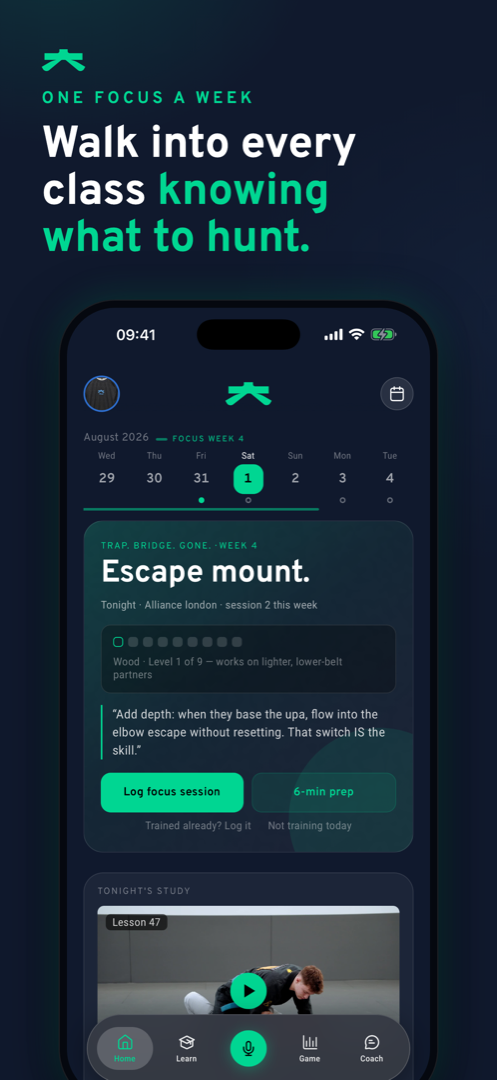
Two minutes. See where your game actually stands →
4Nobody built your game plan around your body
The 24-year-old berimbolo diet is not your path, and following the whole class syllabus equally is volume-thinking again. You need a game built on what actually works for you, proven against real partners: which escapes hold up against heavier people, which sweeps work on better ones. That is exactly what a nine-level proof ladder shows you, technique by technique. Build around what is proven and stop spending your limited mat time on what is not.
5Progress you cannot see feels like age, and it is usually just noise
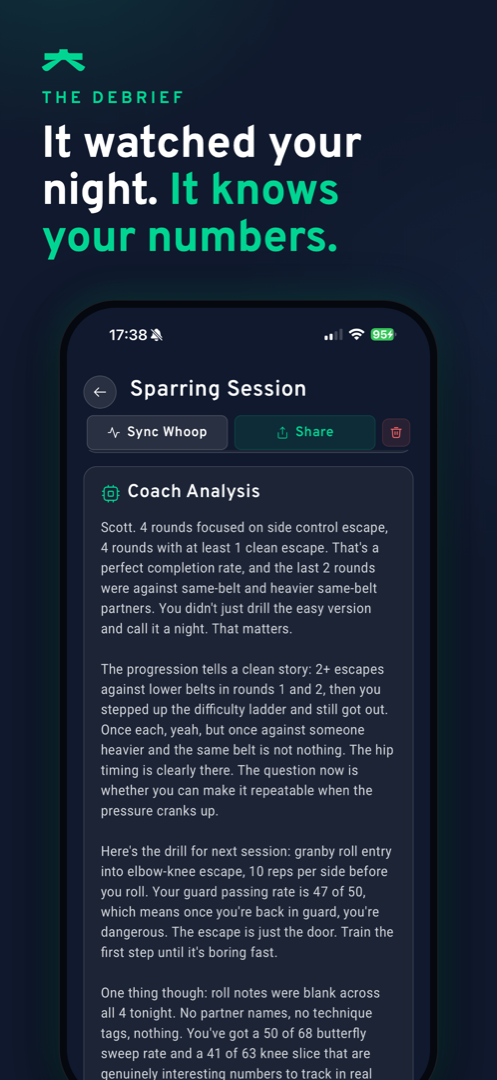
The most dangerous thought after 35 is "maybe I'm too old for this." Nine times out of ten the real problem is that progress went unmeasured, so a normal plateau reads as decline. A 20-second check-in after class and an AI coach that writes your debrief means you see the climb in numbers: this month's proven techniques against last month's. Grapplers who can see it working do not talk themselves into retiring.
What does training BJJ over 35 and 40 actually look like?
We pulled our own member data by age band (September 2026 snapshot, 3,316 adult members). Three or four sessions a week is the most common answer at every age, but two things change steadily as members get older: no-gi-only training falls away, and the share who've trained 10+ years rises.
| Group | Share |
|---|---|
| Under 35 | 52% |
| 35–39 | 48% |
| 40–44 | 47% |
| 45+ | 54% |
At 35-39, 10% train no-gi only, against 22% for members under 35. By 40-44 it's 5%, and at 45+ just 6%. Most of that shifts into training both: 64% of members 45 and over train gi and no-gi. Experience climbs the same way: 12% of 40-44s have trained 10+ years, against 4% of under-35s, which is what you'd expect from people who kept going rather than a sign that starting BJJ later is rare. Our how often to train BJJ guide breaks the same question down by belt, and what is BJJ covers the sport from the very start if you're new to it at any age.
Age bands are under 35, 35-39, 40-44 and 45+, each 384-2,016 people, from the same self-reported onboarding data as our other member-data pages. Patterns, not causes: this describes who answered, not what caused anyone's results.
★★★★★
4.5 from 149 ratings on the App Store
Train smarter, not younger
The quiz is free and takes two minutes. The trial is $1 for seven days of full access, then $39 a year. Cancel in two taps and you are out one dollar.
Take the 2-minute diagnosis →"I look forward to rolling now to get my data." App Store review