A BJJ system for beginners: your first 12 weeks

By Scott Flear, founder of JitsAI. The Focus names are the Foundation focuses in the JitsAI app, built on Henrique Rezende’s fundamentals course.
A good beginner system is one position a week, tested in live rounds. Spend weeks 1 to 4 on escapes, weeks 5 to 7 on guard and weeks 9 to 11 on passing, pinning and finishing, with review weeks at 8 and 12. Count a hit each time it works, note who it worked on, and call it proven after 3 hits across 2 sessions against the same kind of partner.
It works with a notebook or with the app. Your coach’s curriculum comes first: if class covers something else, drill that, and hunt your Focus when you roll.
What happens in your first BJJ classes?
Most classes follow the same shape: a warm-up, a technique shown by the coach, drilling it with a partner, then positional sparring or rolling. You’ll forget most of it by the next class, and that’s normal.
- Tell the coach it’s your first class. They’ll pair you with someone patient.
- Tap early and often. Tap with your hand on your partner or the mat, or say “tap”. Nobody minds.
- Ask before you roll. Some gyms let beginners spar in week one and some wait. Among 1,931 white belts who joined JitsAI, 37% said they hadn’t sparred yet.
- Clean kit, short nails, no jewellery. Ask whether the class is gi or no-gi; our belts guide explains what the colours mean.
How often should a beginner train BJJ?
Pick a number you can keep every week. Here is what white belts told us: of 1,931 white belts, 37% train once or twice a week, 49% three or four times, and 14% five or more times. Three or four sessions a week is the most common answer at every belt; at black belt, 42% train five or more times. These are patterns in who answered, not proof that more sessions cause faster progress.
The 12-week plan below assumes two or three sessions a week; how often to train BJJ compares every belt. If you train more, you’ll prove each Focus sooner; if you train less, give a Focus two weeks.
Which BJJ positions should you learn first?
Escapes first. As a beginner you’ll spend most rounds underneath, so the positions you escape are the ones you train most. Side control is the one members pick most: of 399 JitsAI members who had started a Focus, 42% picked Escape side control, more than any other Focus. Our side control and mount escapes guide has the steps. After the escapes, learn to keep your guard, then to pass and pin, then to finish.
How does the beginner system work?
- One Focus a week. One position and one result, such as “escape side control and recover guard”. Watch one lesson on it before class.
- Test it in live rounds. Ask partners to start you in that position. Try it on lighter and heavier people, and on newer and more experienced ones.
- Count a hit when it lands. A hit is one clean result against resistance. Write down the partner’s size and experience.
- Proven means 3 hits across 2 sessions against the same kind of partner. One good night is a hit, not proof.
- Climb the ladder. JitsAI uses nine levels: levels 1 to 3 are partners less experienced than you (lighter, same weight, heavier), 4 to 6 are partners at your level, and 7 to 9 are more experienced partners. Proving a Focus at level 1 is a real start.
The same idea, applied past the beginner stage, is in how to get better at BJJ.
What should you work on each week for 12 weeks?
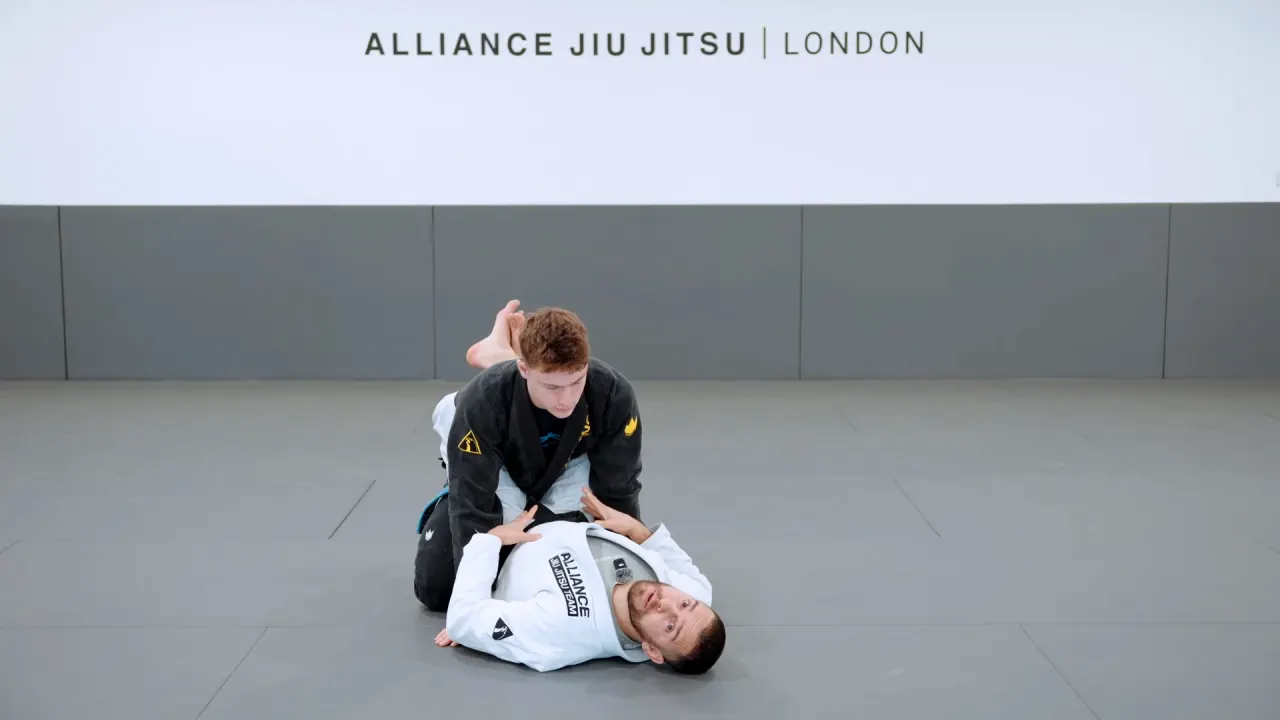
- Week 1 · Survive: Escape side control. Start rounds underneath side control. Frames in, hips out, and recover guard. One or two clean escapes a session is a good week.
- Week 2 · Survive: Escape mount. Start under mount. Trap an arm and bridge; when they base out, switch to the elbow escape without restarting.
- Week 3 · Survive: Escape back control. Start with their seatbelt on. Protect your neck first, then clear a hook. Surviving the round counts.
- Week 4 · Survive: Escape turtle. Start turtled. Turn in and recover guard, or stand up, before they settle on your back.
- Week 5 · Guard: Open guard retention. Let them try to pass. Use your feet, knees and frames to stop the pass and get your guard back.
- Week 6 · Guard: Closed guard sweeps. Break their posture and sweep to the top. Note which sweep lands and on whom.
- Week 7 · Guard: Half guard. From bottom half guard, get the underhook and come up: sweep or wrestle up to your knees.
- Week 8 · Review: Renew your weakest escape. Look back at weeks 1 to 4. Repeat the escape that worked least, against the partners it failed on.
- Week 9 · Top: Pass the guard. Use any pass, clear both legs, and hold side control, north-south or mount for three seconds.
- Week 10 · Top: Side control to mount. Hold side control through their escape attempts, then move to mount.
- Week 11 · Finish: Back chokes. Take the back, keep the seatbelt, and finish the choke with control. Let go the moment they tap.
- Week 12 · Review: Pick your next Focus. Look at what you proved and against whom. Renew what is still fragile; move up the ladder with what held.
Safety: on submission weeks, apply pressure slowly and let go the moment your partner taps.

What does a Focus week look like in the app?
The 12-week plan works with a notebook. In JitsAI, the week’s Focus, the check-in after class and the ladder are tracked for you.
- One Focus a week, with pinned lessons from Henrique Rezende’s 74-lesson fundamentals course.
- A nine-level ladder for every technique, from partners less experienced than you to more experienced ones, each split lighter, same weight and heavier.
- Land it once and it’s a hit; 3 wins across 2 sessions and it’s proven.
$1 for 7 days, then $39 a year.
iPhone and Android.
Pick ONE thing One position for the week: an escape, a guard, a sweep.
Test it on everyone A quick check-in after class: who each round was against, and whether it worked.
Hit, then proven Land it once and it’s a HIT. Three across two sessions and it’s PROVEN.
Know what works See what holds up, against whom, then pick your next Focus.
Brand new to the sport? Start with what is BJJ.
Beginner BJJ questions
What should a beginner learn first in BJJ?
Escapes. Beginners spend most of their rounds underneath, so learning to escape side control, mount and back control pays off in every class. Among 399 JitsAI members who had started a Focus, 42% picked Escape side control, more than any other.
How often should a beginner train BJJ?
Pick a number you can keep every week; consistency beats a big first month. Of 1,931 white belts who told us how often they train, 37% train once or twice a week, 49% three or four times, and 14% five or more times.
What happens in your first BJJ class?
Most classes run a warm-up, then a coach shows a technique, you drill it with a partner, and many classes end with positional sparring or rolling. Tell the coach it is your first class, tap early and often, and ask before you roll.
Do beginners spar in BJJ?
Some gyms let beginners roll in the first week and others wait. Among 1,931 white belts who joined JitsAI, 37% said they hadn’t sparred yet. Ask your coach what your gym does.
How long does it take to get good at BJJ?
Longer than most sports. 74% of the white belts in our data have trained for under a year, and the IBJJF sets no minimum time at white belt. Measure progress by what works in live rounds, not by belts: one position a week, tested on real partners.
Do I need an app to follow this 12-week plan?
No. A notebook works: write down the week’s Focus, tick each time it works, and note the partner’s size and experience. JitsAI does the same tracking with a quick check-in after class and scores it on a nine-level ladder.
About the data
Training frequency and experience: self-reported answers from 3,316 adults (18 and over) who joined JitsAI between 16 October 2025 and 24 September 2026 and told us their belt at sign-up. Snapshot 25 Sep 2026. Full breakdown and a CSV on the BJJ belts page.
Focus picks: 399 members who had started at least one Focus in the app, same snapshot. A member can start more than one.
What we publish: totals only, groups of at least 50 people, and no share that rests on fewer than 10. Founder accounts are excluded and percentages are rounded. Most members found JitsAI through our ads, so this is a big sample but not a random one, and it leans towards people who want to improve and compete. The numbers describe patterns, not causes.