The kimura: steps, common mistakes and when it works
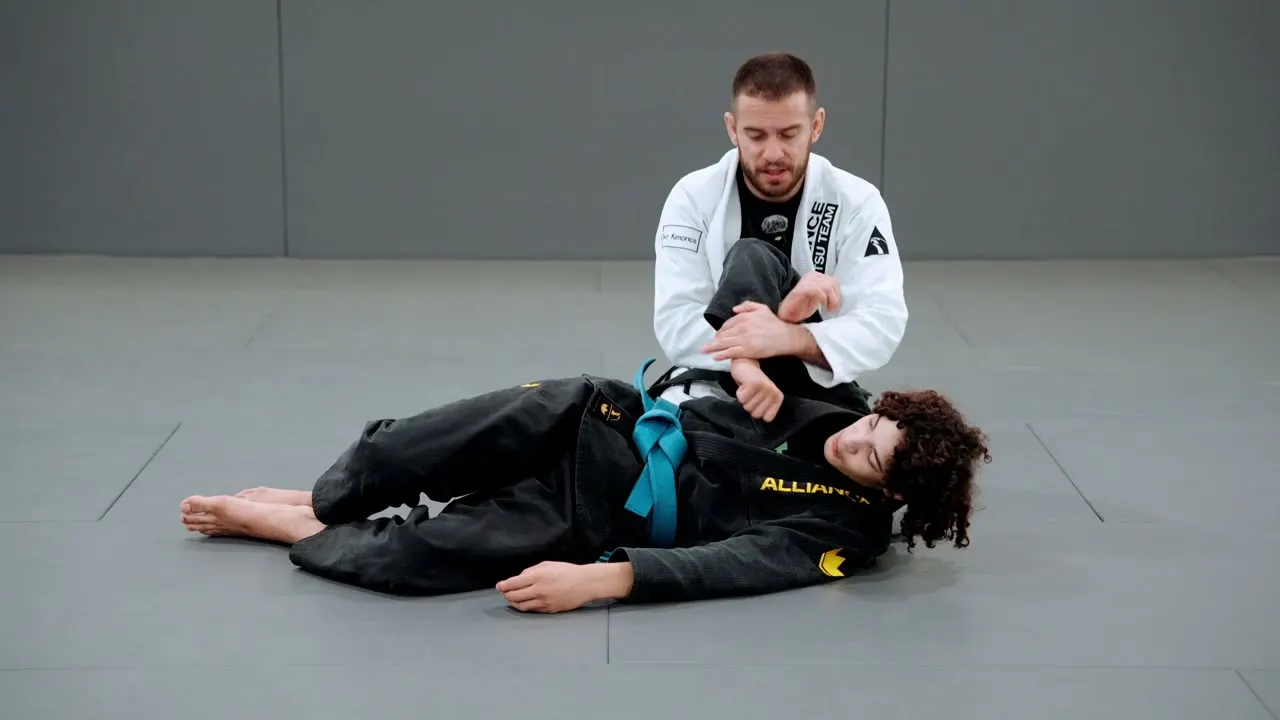

By Scott Flear, founder of JitsAI. Steps from Henrique Rezende’s fundamentals course.
The kimura is a shoulder lock: grip your opponent’s wrist, reach your other hand under their elbow to hold your own wrist, then rotate their hand up behind their back. The finish comes from that rotation and from keeping their elbow pinned to their body, not from pulling harder. It works from side control, the bottom of guard, and after a takedown.
What is a kimura in BJJ?
The kimura is a shoulder lock. Its Japanese name is udegarami, but almost everyone in BJJ calls it the kimura. As Henrique tells it in JitsAI’s fundamentals course, the name comes from judo world champion Masahiko Kimura, who used the submission against Helio Gracie in a famous 1951 match; the name stuck in Brazilian jiu-jitsu ever since.
How do you do a kimura?
- Step 1: Get the kimura grip. With one hand, hold your opponent’s wrist on the arm you want to attack. Reach your other hand under their elbow and hold your own wrist, so their forearm sits inside a figure-four. This grip alone gives you strong control of their shoulder and elbow, even before you attack.
- Step 2: Control their posture. Keep their trapped elbow pinned close to their body. If they can straighten that arm or post it on the floor, the grip loses most of its control.
- Step 3: Rotate their hand behind their back. Bring their wrist up and back, toward their own shoulder blades. That rotation is what twists the shoulder, not raw pulling strength.
- Step 4: Finish by lifting your elbow, not just twisting your wrist. Lift your bottom elbow while keeping the figure-four locked, so the pressure runs through their shoulder joint. Apply it slowly and stop the moment your partner taps.
Safety: apply the rotation slowly and stop the instant your partner taps. A kimura can injure the shoulder quickly if it’s forced.
Where does the kimura work from?
Once you have the grip, the kimura is less a single sequence and more a control position you can attack from in several places:
- From side control. If your opponent’s arm is above your shoulders while you hold side control, block their hip, turn to face their head, and let their arm swing across your face as you turn. Drop your knee down to lock the kimura.
- From the bottom of guard. When your opponent posts a hand flat on the floor in front of you, grab their wrist and sit up into the figure-four. Hip escape to improve your angle before you finish.
- From behind, after a takedown. If you land behind your opponent after a takedown, the kimura grip is one of the fastest ways to control the arm nearest their head while you decide whether to finish it, take the back, or go to an armbar.
It works in the gi and no-gi alike, since the grip is on the wrist and arm rather than the cloth; our no-gi jiu-jitsu guide covers how the two rule sets differ more broadly.
Common mistakes with the kimura
- Trying to finish before controlling the elbow. If the trapped elbow drifts away from the body, the shoulder has room to rotate out of the lock. Keep it pinned before you try to move their hand anywhere.
- Pulling the wrist instead of rotating it. A straight pull mostly fights your opponent’s strength. Rotating the wrist up toward their shoulder blades uses the lever the grip is built for.
- Forgetting the arm can go to a different attack. If your opponent turns into you or defends the shoulder lock, the same kimura grip sets up back takes and armbars. Losing the finish does not mean losing the position.
If a finish stalls, the escapes on our side control and mount escapes page are the same principle from the other side: control first, then move.

Is your kimura actually proven, or does it just work sometimes?
A submission that lands on a beginner and one that lands on a resisting blue belt are different results. JitsAI scores each technique against a nine-level ladder by partner size and experience, so you know who it really works on.
- One Focus a week, with pinned lessons from Henrique Rezende’s 74-lesson fundamentals course.
- A nine-level ladder for every technique, from partners less experienced than you to more experienced ones, each split lighter, same weight and heavier.
- Land it once and it’s a hit; 3 wins across 2 sessions and it’s proven.
$1 for 7 days, then $39 a year.
iPhone and Android.
Pick ONE thing One position for the week: an escape, a guard, a sweep.
Test it on everyone A quick check-in after class: who each round was against, and whether it worked.
Hit, then proven Land it once and it’s a HIT. Three across two sessions and it’s PROVEN.
Know what works See what holds up, against whom, then pick your next Focus.
Kimura questions
What is a kimura in BJJ?
The kimura is a shoulder lock. You trap an opponent’s arm in a figure-four grip and rotate their wrist up behind their back, twisting the shoulder joint until they tap.
Why is it called a kimura?
The technique’s Japanese name is udegarami. As Henrique tells it in JitsAI’s fundamentals course, it became known as the kimura after judo world champion Masahiko Kimura used it against Helio Gracie in a famous 1951 match, and the name stuck in Brazilian jiu-jitsu from then on.
Is the kimura a gi or no-gi technique?
Both. The grip does not need the gi, which is why it shows up as often in no-gi grappling as it does in the gi. See our no-gi jiu-jitsu guide for how the two rule sets compare.
Where can you do a kimura from?
Many places: side control, the bottom of closed guard, back takes off a sprawl, and as a counter when an opponent shoots for a single leg. Henrique’s course covers it as one grip with several different attacks, not one fixed sequence.
What is the most common mistake with the kimura?
Trying to finish it as a pull instead of a rotation, and letting the opponent’s elbow drift away from their body while you set it up. Control the elbow first, then rotate the wrist toward their shoulder blades.
About the data
Training frequency and experience: self-reported answers from 3,316 adults (18 and over) who joined JitsAI between 16 October 2025 and 24 September 2026 and told us their belt at sign-up. Snapshot 25 Sep 2026. Full breakdown and a CSV on the BJJ belts page.
What we publish: totals only, groups of at least 50 people, and no share that rests on fewer than 10. Founder accounts are excluded and percentages are rounded. Most members found JitsAI through our ads, so this is a big sample but not a random one, and it leans towards people who want to improve and compete. The numbers describe patterns, not causes.