How to get better at BJJ: a plan that proves what works

By Scott Flear, founder of JitsAI. This is the method the JitsAI app runs, written so you can use it with a pen.
To get better at BJJ, give every class a job and keep score. Pick one position a week, test it in live rounds against every kind of partner, and write down each clean result with the partner’s size and experience. Review the week: 3 hits across 2 sessions against the same kind of partner means it’s proven. Then test it on harder partners.
Why do most grapplers plateau?
Not because of talent (the short version is in why you’re not getting better at BJJ). The usual pattern is training with no target and no score:
- Every round is different, so nothing is tested. You try a bit of everything and can’t say what worked.
- Progress is measured by feel. A good night feels like progress; a bad one feels like decline. Neither is a measurement.
- Wins come against the same partners. A sweep that works on newer, lighter people hasn’t been tested where it matters.
- Moves get collected, not proven. Saving another video feels productive. It isn’t the same as landing the move under resistance (more in stop collecting moves).
Usually the whole game isn’t stuck. The plateau has a position: one or two places where the round keeps going wrong.
What is a plan that actually works?
- Pick one position a week. Choose the position you lose most often, and one result in it: escape side control, sweep from closed guard, pass the guard. Write it down before class.
- Test it on everyone. Ask partners to start you there. Try it on lighter and heavier people, and on newer and more experienced ones. Every attempt is data.
- Keep score by partner type. After class, note each clean result and who it was against: their size and their experience compared with yours. A hit on a newer, lighter partner and a hit on a heavier, better one are different results.
- Review every week. At the end of the week, look at the score. Proven means 3 hits across 2 sessions against the same kind of partner. If it is proven, move on; if it is fragile, renew it for another week.
- Move up the ladder. Once a position is proven against newer partners, test it on partners at your level, then on more experienced ones. The harder partner is the next level.
New to jiu-jitsu? Start with the 12-week beginner system, which sets the first twelve Focus weeks for you, or go straight to the steps for side control and mount escapes and the kimura.
How do you keep score by partner type?
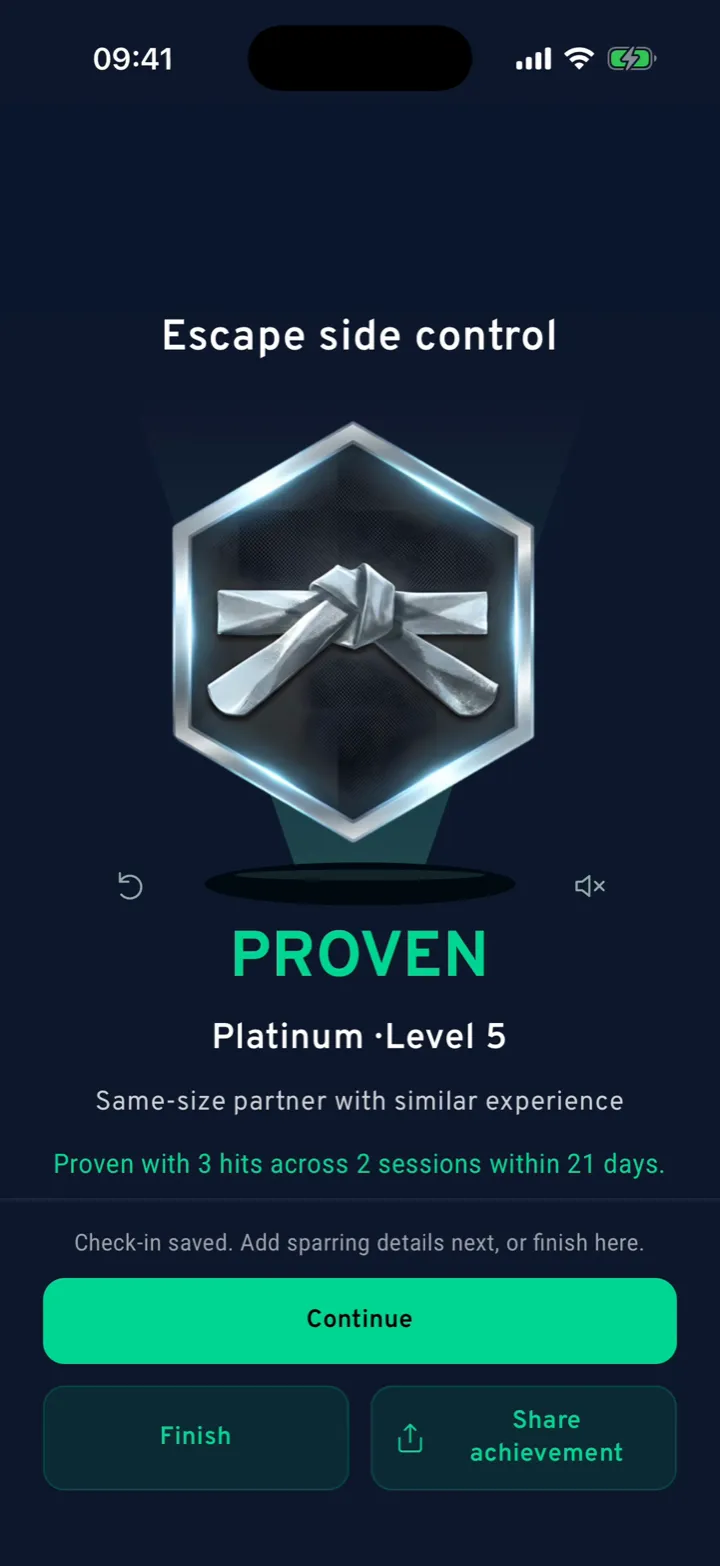
Sort every partner by two things: experience compared with you (less, about the same, more) and size (lighter, same weight, heavier). That gives nine kinds of partner. JitsAI turns them into a nine-level ladder, one level per kind of partner, and each level is proven on its own.
| Levels | Tiers in JitsAI | Partner |
|---|---|---|
| 1 to 3 | Wood, Bronze, Silver | Less experienced than you: lighter, same weight, then heavier |
| 4 to 6 | Gold, Platinum, Diamond | About your experience: lighter, same weight, then heavier |
| 7 to 9 | Gladiator, Praetorian, Emperor | More experienced than you: lighter, same weight, then heavier |
One clean result is a hit. Three hits across at least two sessions against the same kind of partner is proven. “It worked once” and “it works on people my size and level” are different claims, and the score keeps them apart (why worked once isn’t yours yet).

What does keeping score look like in the app?
The ladder above is how JitsAI works: pick one Focus, check in after class, and every result is scored against the kind of partner it came from.
- One Focus a week, with pinned lessons from Henrique Rezende’s 74-lesson fundamentals course.
- A nine-level ladder for every technique, from partners less experienced than you to more experienced ones, each split lighter, same weight and heavier.
- Land it once and it’s a hit; 3 wins across 2 sessions and it’s proven.
$1 for 7 days, then $39 a year.
iPhone and Android.
Pick ONE thing One position for the week: an escape, a guard, a sweep.
Test it on everyone A quick check-in after class: who each round was against, and whether it worked.
Hit, then proven Land it once and it’s a HIT. Three across two sessions and it’s PROVEN.
Know what works See what holds up, against whom, then pick your next Focus.
Printable weekly template
My BJJ Focus week
Focus (one position and one result): ______________________________ Week of: __________
| Session | Partner size (lighter / same / heavier) | Experience (less / same / more) | Hit? (✓ / ✗) | What stopped it |
|---|---|---|---|---|
| Session 1 | ||||
| Session 2 | ||||
| Session 3 | ||||
Review: Proven against which kind of partner (3 hits, 2+ sessions)? __________ Next week: renew / move up / new Focus
jitsai.com/how-to-get-better-at-bjj/
How often should you train to get better?
As often as you can keep up, week after week. Here is how often members told us they train, by belt: the share who train five or more times a week.
| Belt | Members | Train 5+ times a week |
|---|---|---|
| White | 1,931 | 14% |
| Blue | 818 | 16% |
| Purple | 321 | 25% |
| Brown | 129 | 21% |
| Black | 117 | 42% |
Three or four sessions a week is the most common answer at every belt. Black belts are the most likely to train five or more times, but that is a pattern in who answered, not proof that more sessions cause promotion. See the full breakdown on the BJJ belts page and in how often to train BJJ.
What should you ask in your weekly review?
- Did the Focus land, and against which kind of partner?
- What stopped it when it failed: grips, timing, their size, their experience?
- Is it proven, fragile, or not working yet? Renew fragile ones for a second week.
- Which harder partner is next?
Questions about getting better at BJJ
How do you get better at BJJ faster?
Give every class a job. Pick one position a week, test it in live rounds against different partners, count each clean result and who it was against, and review the score at the end of the week. Proven means 3 hits across 2 sessions against the same kind of partner.
Why am I not getting better at BJJ?
Often because training has no target: you roll, you survive, and nothing is measured. The fix is to pick one position, test it on purpose and keep score, so you can see what works and against whom.
How often should I train BJJ to improve?
As often as you can keep up week after week. Members told us how often they train: 14% of white belts train five or more times a week, against 42% of black belts. Three or four times a week is the most common answer at every belt. That is a pattern, not proof that more sessions cause progress.
How do I break a BJJ plateau?
Find the position the plateau lives in. Most plateaus are one or two positions that keep failing against partners at your level. Make that position your Focus, test it on those partners, and keep going until it is proven.
Should I keep a BJJ journal?
Yes, if it records something you can act on. A short note after class is enough: the week’s Focus, each clean result, and the partner’s size and experience. The printable template on this page does exactly that.
About the data
Training frequency and experience: self-reported answers from 3,316 adults (18 and over) who joined JitsAI between 16 October 2025 and 24 September 2026 and told us their belt at sign-up. Snapshot 25 Sep 2026. Full breakdown and a CSV on the BJJ belts page.
What we publish: totals only, groups of at least 50 people, and no share that rests on fewer than 10. Founder accounts are excluded and percentages are rounded. Most members found JitsAI through our ads, so this is a big sample but not a random one, and it leans towards people who want to improve and compete. The numbers describe patterns, not causes.