Why BJJ Tracking Apps Don't Work (I Built One That Didn't)
By Scott, founder of JitsAI
★★★★★ 4.5 from 149 App Store ratings
We're going to be upfront with you, because this story cost us a fortune to learn.
You love jiu-jitsu. You're getting addicted. You want to get better, and somewhere along the way you decided you should track your training. We had the same idea, so we built the app for it. And I mean properly built it: voice logging, round by round, full rolls, lessons, everything. Social dashboard. Leaderboards. It was a jiu-jitsu heaven of an app, and people loved it. The design, the first day. Wow.
Then we watched the data.
More than 20,000 people have downloaded and used our apps. Only about one in four ever really logged. Most people logged once or twice, decided it was too much, and never logged again. The best-designed tracker we knew how to build, and the data said most people never used the tracking at all.
And here is the detail that matters: we made logging as easy as it has ever been in this sport. We were the first to build voice logging for jiu-jitsu. Talk about your rounds, tap what you did, done. Other apps have copied it since, and fair enough, because it works: almost everyone who did log used it. But even with the easiest logging on earth, only about one in four ever logged at all. Easy was not the missing piece. A goal was. People will not record aimless training, because deep down they know there is nothing worth recording.
That number ended the argument. Here is what it taught us.
1People do not log their jiu-jitsu if it takes effort
We made logging as easy as we could, and it was still homework after the hardest hour of your day. Any system that depends on your discipline after training is dead on arrival. It does not matter how beautiful it is. The graveyard of every BJJ journal is the same: three entries, then silence. Ours had nicer headstones.
2Logging random rolls records the problem instead of fixing it
Even when people did log, there was a deeper issue. You still have to remember what happened in each round. And you probably rolled each round randomly anyway, hoping for the best, going for death rolls with no goal in mind. So there was nothing worth remembering. A perfect record of aimless training is still aimless training. Tracking for the sake of insights was never the point. Getting better is the point.
3A diary is not a coach
Say you keep the journal anyway. Now you own a wall of text. Which techniques actually work? Against who? What should Thursday's focus be? The journal does not know. You did the work of a secretary and got the insight of a shoebox full of receipts. What you needed was the right instruction at the right moment, and no tracker on the market delivers that.
Comparing options? We list ten BJJ apps side by side, ours included, with what each is for and what it costs: best BJJ apps in 2026.
Skip the graveyard. See the loop on your own game →
So we went and asked the best on earth
We stopped trying to build the best jiu-jitsu journal and started asking a different question: what system would actually make someone better, week after week?
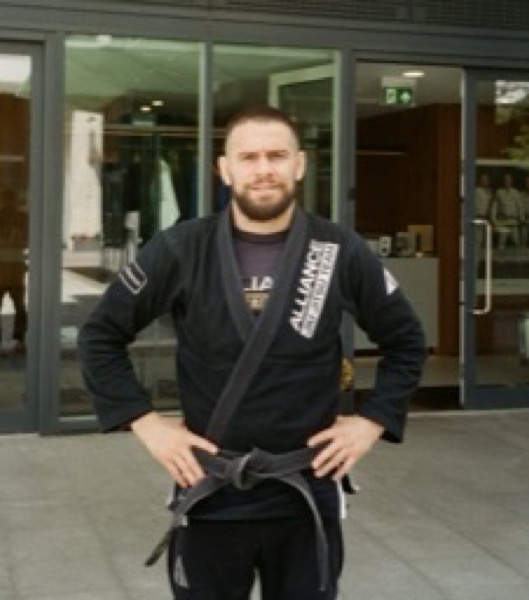
We brought in Henrique Rezende, world champion and head coach of Alliance London, who is now part of JitsAI. We sponsored the Alliance seminar with Lucas Lepri and took a private lesson with him to pick his brain. We filmed with Matheus Spirandeli. We put the question to world-class teachers and built the answer into software.
The answer was never "track more." It was a loop. Pick one thing. Prepare for it properly. Test it live. Get told what to fix. Repeat.
What the rebuilt app actually does
JitsAI now runs on one rule: in and out within 30 seconds, and you get what you need. The Pareto principle, applied to jiu-jitsu. The whole system is one loop:
You pick something to work on. Before class you watch a three-to-four minute video on exactly that, from Henrique, that gets straight to the point. Not a three hour instructional you fall asleep in. Then you try it on real people in live sparring, and this is where the logging gets serious.
Every attempt is recorded against who it actually happened on: lighter, same weight or heavier, and less experienced, same, or more. Because hitting a sweep on a smaller white belt and hitting it on a heavier blue belt are different achievements, and your game log should know the difference. Here is what that looks like for real, from my own account, my last three focus weeks:
MY LAST THREE FOCUS WEEKS · REAL DATA
| Tue | 5 attempts, 3 sweeps | lighter, higher belt |
| Wed | 1 attempt, 0 | heavier, same level |
| Thu | 2 attempts, 1 sweep | same size, same level |
| Fri | 2 attempts, 1 sweep | lighter, higher belt |
The verdict wrote itself: the sweep is real against lighter and level partners, and it dies against weight. My next job is not "get better at butterfly." It is "make the elevation work on heavier people." That is a focus week. That is the whole system.
Want to say more than taps? Voice log it. Talk about your rounds like you are telling a friend, messy as you like, and it comes back as structured jiu-jitsu data: techniques, partners, attempts, outcomes. We spent seven months building that system and we think it is the best in the world at exactly this one job. The coach in the app works from whatever you give it, so the more you talk, the sharper it coaches. Never required, always rewarded.
Then every week you get the verdict: are you actually getting better, and on who. If yes, the loop moves on. If not, the loop tells you why. Either way you keep looping.
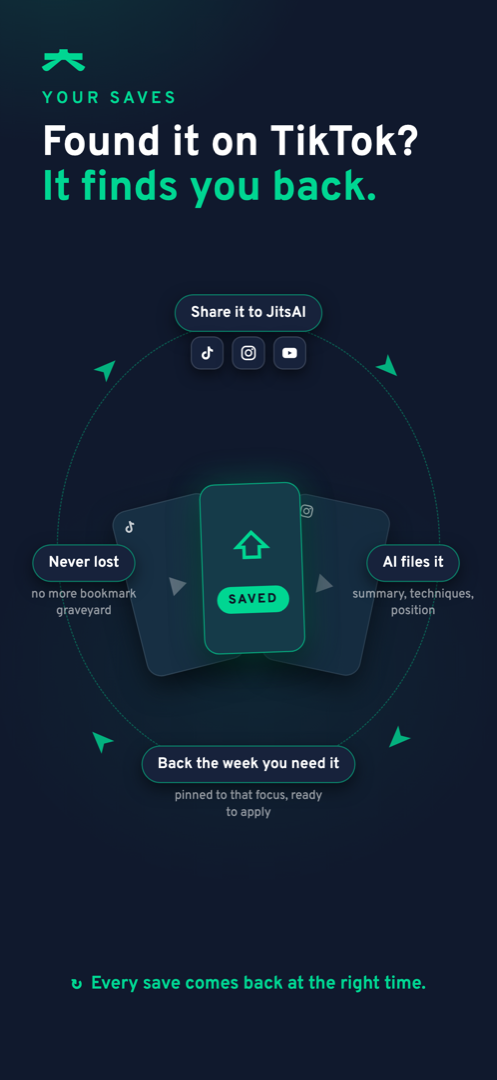
The organising happens without you. Rolls filed, focus weeks reviewed, and anything you see on social media saved: send a technique to JitsAI when you spot it and it resurfaces exactly when it matches your focus week, instead of dying in your bookmarks with hundreds of others you wished would stick.
And progression is built in, with a brutal starting prescription: test your fundamentals first, because you are probably lacking there. Most people are. Escapes, guard retention, base. Prove those on the ladder, then move up:
Over 100 ladders to climb in the app, each running the nine ranks:

Wood

Bronze

Silver

Gold

Platinum

Diamond

Gladiator

Praetorian

Emperor
You start with one ladder. Every technique needs three wins across two different sessions before it counts as proven, and you can chat with a coach that knows your whole game, because it did the record-keeping for you.
We stopped trying to be the best jiu-jitsu app. We built the thing that gets you better. People use this one.
★★★★★
4.5 from 149 ratings on the App Store
People use this one
The quiz is free and takes two minutes. The trial is $1 for seven days of full access, then $39 a year. Cancel in two taps and you are out one dollar.
Start with the 2-minute diagnosis →"I look forward to rolling now to get my data." App Store review