BJJ purple belt test: a free practice exam
30 questions. Free, no sign-up.
Unofficial practice exam. Only your professor can promote you.
This is an unofficial BJJ purple belt practice exam: 30 questions, and at least 28 of them show you something. It is organised like a grading: takedowns, guard passes, guard sweeps, submissions from guard, side control, mount, and back and turtle. You see a position or a move as an animation, a clip from our fundamentals course or a technique image, and you name it, pick the moves that start from there or say where it ends. One question covers rules and scoring. It is set at purple belt level: the wrong answers are near-misses from the same position, and many questions ask for a grip, a hip or the follow-up when the opponent defends. There is no official purple belt test: the IBJJF sets a minimum age of 16 and time at blue belt, and your professor decides.
 BJJ purple belt practice exam
Leave the exam? Your answers so far will be lost.
Unofficial practice exam
BJJ purple belt practice exam
30 questions across 8 areas. You answer each one once: no going back.
- Takedowns and throws
- Guard passes
- Guard sweeps
- Submissions from guard
- Side control
- Mount
- Back and turtle
- Rules and safety
Unofficial practice exam. Only your professor can promote you.
Unofficial practice exam
30 questions, one at a time. You see the answer and why after each one. Nothing is saved and there is no sign-up.
Unofficial practice exam. Only your professor can promote you.
Animations from JitsAI’s card game (GrappleMap, public domain). No-gi only.
Rules and safety
Which of these may a purple belt use at IBJJF events?
The toe hold, knee bar, calf slicer and biceps slicer are illegal for blue and purple belts. The straight foot lock is not.
Rules and safety
From 2027, may a purple belt turn toward the foot that is not being attacked while finishing a straight foot lock?
From 1 January 2027 the turn is no longer illegal for blue and purple belts. Brown and black belts were already allowed.
Rules and safety
You grip the opponent’s lapel and wrap your own leg in a controlling position. Under the 2027 rules, how long do you have to progress?
You have 20 seconds to progress, or you get a lack of combativeness penalty, regardless of intention.
Rules and safety
After a double guard pull, you lock in a submission at 19 seconds and nobody has come on top or scored. What happens at 20 seconds under the 2027 rules?
From 2027 the match is stopped regardless of whether a submission is in hold.
Rules and safety
May a purple belt use a heel hook at IBJJF events?
The heel hook is legal only for adult brown and black belts in no-gi.
Rules and safety
Points are level at the end of an IBJJF match. What decides it, in order?
If points are level, advantages decide, then penalties, then the referee.
Rules and safety
The match is interrupted while you have a submission locked in, for a reason that is nobody’s fault. Under the 2027 rules, what do you get?
The match restarts standing in the centre and the athlete who had the hold gets 2 points.
Rules and safety
You hold a grip on the trousers, your opponent pulls closed guard and stays suspended in the air. From 2027, how do you earn the takedown points?
The 3-second limit is removed: cause them to land on their back, sideways or seated. Stabilising the top position for 3 seconds still applies.
Side control
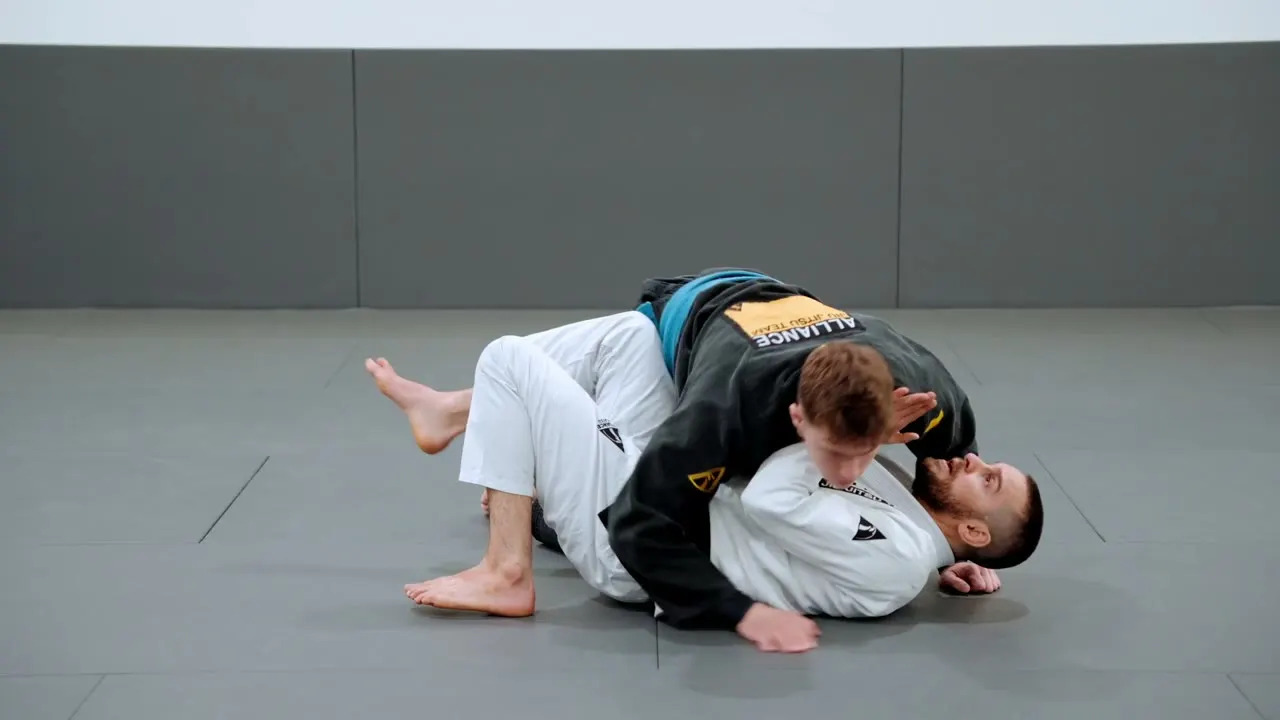
Clip from JitsAI’s fundamentals course with Henrique Rezende.
In the side control escape, what finishes the recovery to guard?
Block their leg from following you round, bring your other knee in front of their hip, and finish the hip escape to close your guard.
Mount
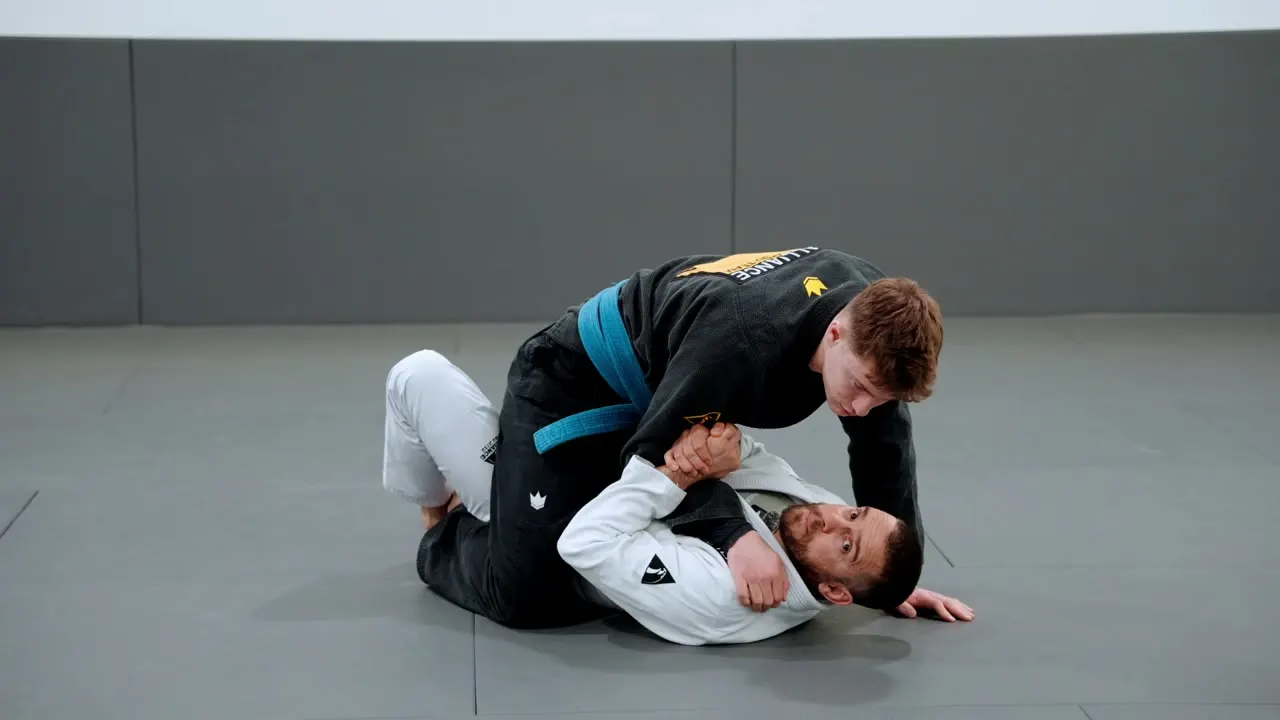
Clip from JitsAI’s fundamentals course with Henrique Rezende.
You are the fighter in white.
Elbow escape from mount, second side: what do your hands do?
Push their knee with one hand and block their biceps with the other so they cannot cross-face you.
Side control
Clip from JitsAI’s fundamentals course with Henrique Rezende.
Why is a bridge on its own not an escape from side control?
A bridge alone will not get you out, but it opens the gap a hip escape needs.
Side control
The video plays once you have answered.
What makes a wrist lock work?
Pin the elbow so only the wrist can bend, then bend the hand past its range. It comes on fast, so finish slowly.
Mount
Clip from JitsAI’s fundamentals course with Henrique Rezende.
What does your hand grip in an Ezekiel choke?
One arm goes behind the head with that hand gripping inside your other sleeve, and the other forearm crosses the throat like scissors.
Takedowns and throws
Clip from JitsAI’s fundamentals course with Henrique Rezende.
Watch the clip. Which throw is this?
Osoto gari, the judo outer reap.
Side control
Clip from JitsAI’s fundamentals course with Henrique Rezende.
Watch the clip. Which submission is he setting up from side control?
The kimura, here from side control. It is a shoulder lock.
Submissions from guard
You are the fighter in white.
You sit back for the armbar and the elbow keeps sliding off your hips. Which fault does that point to?
A gap between your hips and their armpit lets the elbow slip out. The other three are what you want.
Submissions from guard
You are the fighter in white.
Finishing an armbar, which way should their thumb point, and why?
Thumb to the ceiling lines the elbow up with your hips. With the thumb sideways the pressure leaks out.
Submissions from guard
You are the fighter in white.
You attack an armbar and they defend the arm. Which pair are the classic switches?
When they defend the arm, the triangle and the kimura are the classic switches.
Submissions from guard
You are the fighter in white.
Your triangle is locked but it only hurts their jaw. What do you fix first?
Square on, your thigh sits on the jaw. Cut the angle so the thigh is on the side of the neck, then squeeze.
Submissions from guard
You are the fighter in white.
Locking the triangle, where does your ankle go?
Lock behind the knee. An ankle on the shin or a hand on the toes is loose and strains your own knee.
Submissions from guard
You are the fighter in white.
Triangle: what goes wrong with both arms in, and with both arms out?
With both arms in they can stack you and pass; with both out there is no second wall. One in, one out.
Submissions from guard
You are the fighter in white.
The figure four is locked and the angle is right. What packs their own shoulder into their neck?
Drive the trapped elbow across so their own shoulder packs into the side of the neck.
Submissions from guard
You are the fighter in white.
You attack a triangle and they pull the trapped arm out. Which attack does the same guard now set up?
When they defend the triangle by pulling the arm out, the same guard sets up the armbar.
Submissions from guard
You are the fighter in white.
From closed guard, which reaction from the opponent opens the kimura?
When they post a hand on the floor, grab the wrist and sit up into the figure-four.
Submissions from guard
You are the fighter in white.
Kimura: what actually twists the shoulder?
The rotation up and back is the lever. A straight pull only fights their strength.
Submissions from guard
You are the fighter in white.
Before you move their hand anywhere in a kimura, what must be controlled?
If the elbow drifts from the body, the shoulder has room to rotate out. Pin it first.
Submissions from guard
You are the fighter in white.
You have the kimura grip and they turn into you to defend the shoulder. What does the same grip set up?
If they turn in or defend the shoulder lock, the same grip sets up back takes and armbars.
Submissions from guard
You are the fighter in white.
Guillotine: where does the blade of your forearm sit?
The thumb side of the forearm goes across the front of the throat. On the chin you are squeezing bone.
Submissions from guard
You are the fighter in white.
You have a guillotine from guard and they start to posture up. What keeps the choke?
If they can posture up or walk round, the choke loosens. From guard, close your legs and pull them in.
Submissions from guard
You are the fighter in white.
Where does the finish of a guillotine come from?
A biceps curl tires out fast. Arch back and lift up and back through the throat. Twisting makes it a neck crank.
Submissions from guard
You are the fighter in white.
Omoplata: their shoulder is down, then they roll forward and escape. What did you miss?
Without a hold on their back or far hip they roll forward out of it. Sit up and grab it straight away.
Submissions from guard
You are the fighter in white.
From closed guard with their posture broken, what comes straight before the leg swings over the shoulder?
Hip out and push the head first. If your hips do not get out to the side, the leg cannot get over the shoulder.
Submissions from guard
You are the fighter in white.
You swing your leg over for the omoplata and they posture up. What is often there instead?
If they posture up as you swing your leg, the triangle is often there instead.
Submissions from guard
You are the fighter in white.
Mid-omoplata their arm straightens and the lever is gone. What slipped?
Once their hand slides free of your hip, the arm straightens and the lever is gone.
Submissions from guard
Clip from JitsAI’s fundamentals course with Henrique Rezende.
Straight foot lock: where does the bony edge of your wrist sit?
Just above the heel. Too high and the pivot is on muscle; in the elbow crease there is no hard pivot.
Submissions from guard
Clip from JitsAI’s fundamentals course with Henrique Rezende.
You have the foot trapped and lie back, and nothing happens. What is missing?
Lying back without arching does little. The finish comes from your hips driving forward.
Submissions from guard
Clip from JitsAI’s fundamentals course with Henrique Rezende.
Setting up a straight foot lock from a basic leg entanglement, where do your legs go?
Outside foot on the hip, inside leg threaded between their legs to control the knee.
Submissions from guard
The video plays once you have answered.
Knee bar: where should their knee sit against you?
If your hips sit above their knee you bend the thigh, not the joint. Slide until the knee is on your hip line.
Submissions from guard
The video plays once you have answered.
Knee bar: which side do you fall to, and why?
The free leg is their main tool for escaping. Fall to that side so your body pins it.
Submissions from guard
The video plays once you have answered.
Toe hold: what must be done before the grip matters?
If their knee can turn, the leg spins with the grip and the lock disappears. Trap it above the knee first.
Side control
Clip from JitsAI’s fundamentals course with Henrique Rezende.
Americana from side control: which is the most common mistake?
Once the hand comes up, the shoulder is off the hook. The other three are the technique.
Side control
Clip from JitsAI’s fundamentals course with Henrique Rezende.
How does the americana finish?
Wrist flat on the mat, sliding towards their hips, elbow slowly raised. The last option is the kimura.
Side control
Clip from JitsAI’s fundamentals course with Henrique Rezende.
You have the americana grip and they straighten the arm to escape. What is the classic switch?
If they straighten the arm, the armbar is the classic switch. If they turn the hand the other way, you are in a kimura.
Side control
Clip from JitsAI’s fundamentals course with Henrique Rezende.
You have the americana grip and they turn the hand the other way. What are you in now?
The same figure-four with the hand turned the other way is the kimura.
Side control
Clip from JitsAI’s fundamentals course with Henrique Rezende.
Setting the americana, where is their wrist pinned?
Pinned beside the head at or below shoulder level, forearm pointing at their head: a tight L, not reaching overhead.
Side control
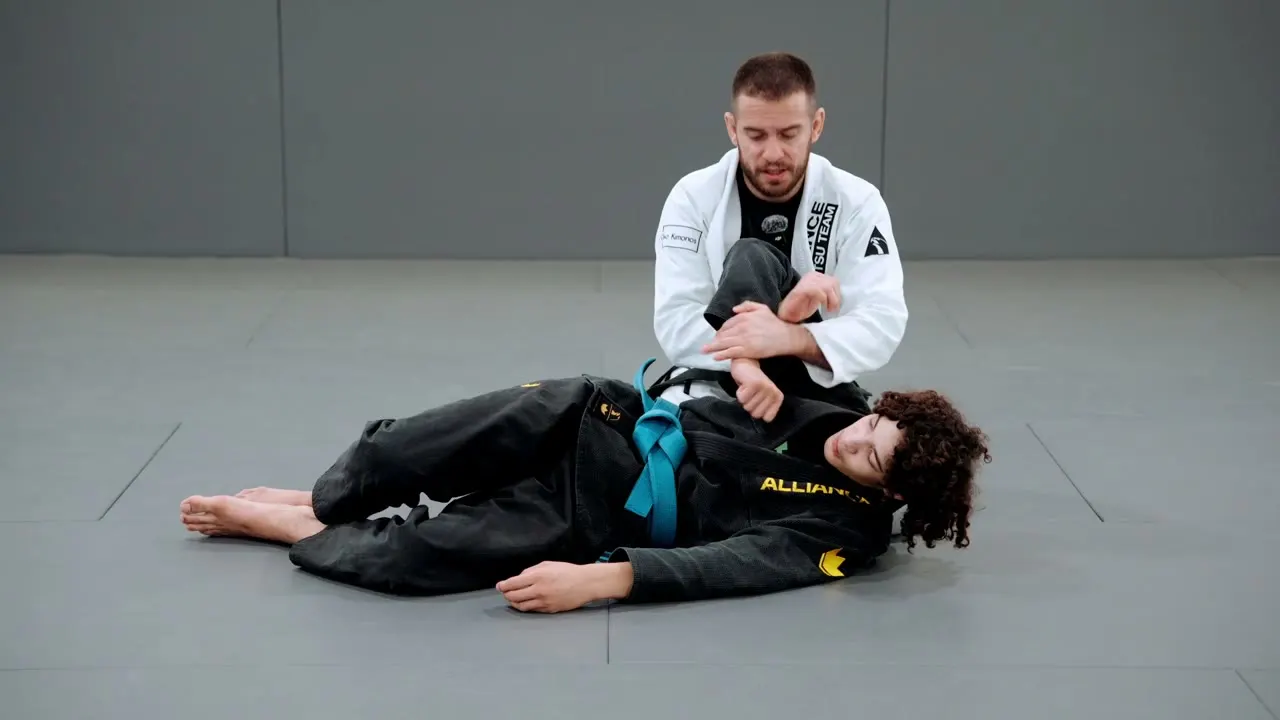
Clip from JitsAI’s fundamentals course with Henrique Rezende.
Watch the clip. From side control, which arm position makes this attack available?
With their arm above your shoulders: block the hip, turn to face their head and drop the knee to lock the kimura.
Mount
You are the fighter in white.
Arm triangle from mount: you squeeze and only squash the jaw. What fixes it?
Staying square only squashes the jaw. Come off to the side your head is on, at about a right angle.
Mount
You are the fighter in white.
Where must their elbow be for the arm triangle to have its second wall?
If the elbow sits in front of the face and not across it, their shoulder is not on the neck.
Mount
You are the fighter in white.
Arm triangle: your head comes up off the mat. What does that give them?
Your head pins the arm against their neck. If it comes off the mat they can pull the arm back out.
Mount
You are the fighter in white.
Armbar from mount: you have climbed high and pinned one arm to your chest. What comes next?
Weight on the hand on their chest, foot up by the head, then the other leg swings over the face as you sit back.
Mount
Clip from JitsAI’s fundamentals course with Henrique Rezende.
Ezekiel from mount: what does the arm behind their head do at the finish?
The scissor needs both arms. Without the back arm lifting the head, the forearm only pushes them into the mat.
Mount
Clip from JitsAI’s fundamentals course with Henrique Rezende.
Ezekiel: both of your arms are round their neck. What is the risk, and the answer to it?
With both arms round the neck you cannot post. Stay heavy on your hips in mount so they cannot bridge you off.
Mount
Clip from JitsAI’s fundamentals course with Henrique Rezende.
The americana from mount uses the same grip as from side control. What changes?
From mount it is the same grip, with your knees wide and your hips heavy so they cannot bridge.
Back and turtle
You are the fighter in white.
Which is the seatbelt grip?
One arm over the shoulder and the other under the armpit, hands together on their chest.
Back and turtle
You are the fighter in white.
On the back with hooks in, why keep your ankles uncrossed?
Crossed ankles in front of their body give them a foot lock: they cross their legs over yours and squeeze.
Back and turtle
You are the fighter in white.
What produces the pressure in a rear naked choke?
Crushing with your hands does not close the neck. Elbows together and chest out, with the grip only holding the shape.
Back and turtle
You are the fighter in white.
Your choking arm sits on the throat with the elbow out in front of their chin. What is wrong?
A shallow arm is uncomfortable for them but rarely finishes. Get the crook of the elbow under the chin first.
Back and turtle
Clip from JitsAI’s fundamentals course with Henrique Rezende.
Bow and arrow: which hook comes out, and where do your hips go?
Take the hook out on the side of your choking arm and swing your hips out that way, so their body lands across your lap.
Back and turtle
Clip from JitsAI’s fundamentals course with Henrique Rezende.
Bow and arrow: the collar grip is deep and you are out to the side. Which two pulls finish it?
The collar and the leg go in opposite directions while your body straightens.
Back and turtle
Clip from JitsAI’s fundamentals course with Henrique Rezende.
They fight your collar grip as you set the bow and arrow. What is the switch?
If they fight the collar grip, switch to the rear naked choke. If they escape to their back, the armbar is often there.
Back and turtle
Clip from JitsAI’s fundamentals course with Henrique Rezende.
D’Arce from the front headlock: which way does the arm thread?
In the d’Arce the arm goes in under the armpit first, then under the neck. Neck first is the anaconda.
Back and turtle
Clip from JitsAI’s fundamentals course with Henrique Rezende.
D’Arce: the grip is locked but you finish face to face and it fails. Why?
Finishing face to face lets their shoulder slip out. Drop to an angle, then get your leg over their body.
Back and turtle
Clip from JitsAI’s fundamentals course with Henrique Rezende.
D’Arce: how deep must the threading arm go?
If only your wrist reaches the neck, you are squeezing the shoulder. Feed the arm until the biceps is on the neck.
Guard passes
You are the fighter in white.
In a knee cut pass, what does the passing knee do?
The knee cut drives one knee across and under the leg to pin it flat on the way to side control. The others are the leg drag, the smash pass and the toreando.
Guard passes
You are the fighter in white.
Which pass is this: you pull the opponent’s leg across your own body to clear it, then pass to side control or the back?
The leg drag pulls the leg across your own body before passing to side control or the back.
Guard passes
You are the fighter in white.
What marks a smash pass?
The smash pass is heavy and pressure-based: flatten the hips to the mat, then move through to side control.
Guard passes
You are the fighter in white.
Which describes the toreando?
The toreando is a fast standing pass, sweeping the legs to one side while stepping round them.
Guard sweeps
You are the fighter in white.
Hip bump sweep: what are the actions, in order?
You sit up, post a hand and drive your hip into the opponent to knock them over.
Guard sweeps
You are the fighter in white.
Which way does a scissor sweep take the opponent?
The scissoring legs off-balance the opponent sideways.
Guard sweeps
Which guard is this: from underneath a standing opponent, one of their legs is controlled between yours while your other leg blocks their base?
X-guard controls one leg between yours from underneath while the other leg blocks their base.
Guard sweeps
Lasso, spider, De La Riva, spider web: which one is the lasso?
The lasso wraps one leg round the arm and sleeve. The others are spider, De La Riva and spider web.
Guard sweeps
You are the fighter in white.
What makes it deep half guard and not half guard?
In deep half you go underneath the opponent’s hips. The shin across the chest is the knee shield.
Guard sweeps
You are the fighter in white.
Half guard with a knee shield: what is the shin for?
The knee shield braces a shin and knee across the chest or hip to control distance and stop them flattening you out.
Takedowns and throws
You are the fighter in white.
Defending a shot with a sprawl, what do the hips and legs do?
A sprawl drops the hips to the mat and kicks the legs back.
Takedowns and throws
You are the fighter in white.
A standing guillotine has no guard to close. What closes the space?
From guard you close your legs; standing, you keep your hips tight to them.
Takedowns and throws
You are the fighter in white.
You land behind them after a takedown and take a kimura grip on the arm nearest their head. Which three choices does that grip give you?
The grip controls the arm while you decide whether to finish it, take the back, or go to an armbar.
Takedowns and throws
Clip from JitsAI’s fundamentals course with Henrique Rezende.
Watch the clip. Name this technique.
Double leg takedown, as taught in this lesson of the fundamentals course.
Takedowns and throws
Clip from JitsAI’s fundamentals course with Henrique Rezende.
Watch the clip. Name this technique.
Single leg takedown, as taught in this lesson of the fundamentals course.
Takedowns and throws
Clip from JitsAI’s fundamentals course with Henrique Rezende.
Watch the clip. Name this technique.
Body lock takedown, as taught in this lesson of the fundamentals course.
Takedowns and throws
Clip from JitsAI’s fundamentals course with Henrique Rezende.
Watch the clip. Name this technique.
O goshi (hip throw), as taught in this lesson of the fundamentals course.
Takedowns and throws
Clip from JitsAI’s fundamentals course with Henrique Rezende.
Watch the clip. Name this technique.
Kouchi gari (small inner reap), as taught in this lesson of the fundamentals course.
Takedowns and throws
Clip from JitsAI’s fundamentals course with Henrique Rezende.
Watch the clip. Name this technique.
Osoto gari (big outer reap), as taught in this lesson of the fundamentals course.
Takedowns and throws
Clip from JitsAI’s fundamentals course with Henrique Rezende.
Watch the clip. Name this technique.
Koshi guruma (hip wheel), as taught in this lesson of the fundamentals course.
Takedowns and throws
Clip from JitsAI’s fundamentals course with Henrique Rezende.
Watch the clip. Name this technique.
Ippon seoi nage (shoulder throw), as taught in this lesson of the fundamentals course.
Takedowns and throws
Clip from JitsAI’s fundamentals course with Henrique Rezende.
Watch the clip. Name this technique.
Snap down to front headlock, as taught in this lesson of the fundamentals course.
Takedowns and throws
Clip from JitsAI’s fundamentals course with Henrique Rezende.
Watch the clip. Name this technique.
Guard pull to closed guard, as taught in this lesson of the fundamentals course.
Guard sweeps
Clip from JitsAI’s fundamentals course with Henrique Rezende.
Watch the clip. Name the guard the player on the bottom is using.
Closed guard, as taught in this lesson of the fundamentals course.
Guard sweeps
Clip from JitsAI’s fundamentals course with Henrique Rezende.
Watch the clip. Name the guard the player on the bottom is using.
Half guard, as taught in this lesson of the fundamentals course.
Guard sweeps
Clip from JitsAI’s fundamentals course with Henrique Rezende.
Watch the clip. Name the guard the player on the bottom is using.
Butterfly guard, as taught in this lesson of the fundamentals course.
Guard sweeps
Clip from JitsAI’s fundamentals course with Henrique Rezende.
Watch the clip. Name the guard the player on the bottom is using.
De La Riva guard, as taught in this lesson of the fundamentals course.
Guard sweeps
Clip from JitsAI’s fundamentals course with Henrique Rezende.
Watch the clip. Name the guard the player on the bottom is using.
Spider guard, as taught in this lesson of the fundamentals course.
Guard sweeps
Clip from JitsAI’s fundamentals course with Henrique Rezende.
Watch the clip. Name the guard the player on the bottom is using.
Lasso guard, as taught in this lesson of the fundamentals course.
Guard sweeps
Clip from JitsAI’s fundamentals course with Henrique Rezende.
Watch the clip. Name the guard the player on the bottom is using.
X-guard, as taught in this lesson of the fundamentals course.
Guard sweeps
Clip from JitsAI’s fundamentals course with Henrique Rezende.
Watch the clip. Name the guard the player on the bottom is using.
Deep half guard, as taught in this lesson of the fundamentals course.
Guard sweeps
Clip from JitsAI’s fundamentals course with Henrique Rezende.
Watch the clip. Which position is this?
Reverse De La Riva guard (RDLR), as taught in this lesson of the fundamentals course.
Guard sweeps
Clip from JitsAI’s fundamentals course with Henrique Rezende.
Watch the clip. Which position is this?
Seated guard (sitting guard), as taught in this lesson of the fundamentals course.
Guard sweeps
Clip from JitsAI’s fundamentals course with Henrique Rezende.
Watch the clip. Name this technique.
Hip bump sweep, as taught in this lesson of the fundamentals course.
Guard sweeps
Clip from JitsAI’s fundamentals course with Henrique Rezende.
Watch the clip. Name this technique.
Scissor sweep, as taught in this lesson of the fundamentals course.
Guard sweeps
Clip from JitsAI’s fundamentals course with Henrique Rezende.
Watch the clip. Name this technique.
Butterfly sweep, as taught in this lesson of the fundamentals course.
Guard sweeps
Clip from JitsAI’s fundamentals course with Henrique Rezende.
Watch the clip. Name this technique.
Pendulum sweep, as taught in this lesson of the fundamentals course.
Guard sweeps
Clip from JitsAI’s fundamentals course with Henrique Rezende.
Watch the clip. Name this technique.
De La Riva sweep, as taught in this lesson of the fundamentals course.
Guard sweeps
Clip from JitsAI’s fundamentals course with Henrique Rezende.
Watch the clip. Name this technique.
Tripod sweep, as taught in this lesson of the fundamentals course.
Guard sweeps
Clip from JitsAI’s fundamentals course with Henrique Rezende.
Watch the clip. Name this technique.
Tripod sweep, as taught in this lesson of the fundamentals course.
Guard sweeps
Clip from JitsAI’s fundamentals course with Henrique Rezende.
Watch the clip. Name this technique.
Spider guard sweep, as taught in this lesson of the fundamentals course.
Guard sweeps
Clip from JitsAI’s fundamentals course with Henrique Rezende.
Watch the clip. Name this technique.
X-guard sweep, as taught in this lesson of the fundamentals course.
Guard sweeps
Clip from JitsAI’s fundamentals course with Henrique Rezende.
Watch the clip. Name this technique.
Single leg X sweep, as taught in this lesson of the fundamentals course.
Guard passes
Clip from JitsAI’s fundamentals course with Henrique Rezende.
Watch the clip. Name this technique.
Knee cut pass, as taught in this lesson of the fundamentals course.
Guard passes
Clip from JitsAI’s fundamentals course with Henrique Rezende.
Watch the clip. Name this technique.
Toreando pass, as taught in this lesson of the fundamentals course.
Guard passes
Clip from JitsAI’s fundamentals course with Henrique Rezende.
Watch the clip. Name this technique.
Over-under pass, as taught in this lesson of the fundamentals course.
Guard passes
Clip from JitsAI’s fundamentals course with Henrique Rezende.
Watch the clip. Name this technique.
Double under pass, as taught in this lesson of the fundamentals course.
Guard passes
Clip from JitsAI’s fundamentals course with Henrique Rezende.
Watch the clip. Name this technique.
Side smash pass, as taught in this lesson of the fundamentals course.
Guard passes
Clip from JitsAI’s fundamentals course with Henrique Rezende.
Watch the clip. Name this technique.
Leg drag, as taught in this lesson of the fundamentals course.
Guard passes
Clip from JitsAI’s fundamentals course with Henrique Rezende.
Watch the clip. Name this technique.
Long step pass, as taught in this lesson of the fundamentals course.
Guard passes
Clip from JitsAI’s fundamentals course with Henrique Rezende.
Watch the clip. Name this technique.
Back step pass, as taught in this lesson of the fundamentals course.
Submissions from guard
Clip from JitsAI’s fundamentals course with Henrique Rezende.
Watch the clip. Name this technique.
Kimura, as taught in this lesson of the fundamentals course.
Submissions from guard
Clip from JitsAI’s fundamentals course with Henrique Rezende.
Watch the clip. Name this technique.
Omoplata, as taught in this lesson of the fundamentals course.
Submissions from guard
Clip from JitsAI’s fundamentals course with Henrique Rezende.
Watch the clip. Name this technique.
Triangle choke, as taught in this lesson of the fundamentals course.
Submissions from guard
Clip from JitsAI’s fundamentals course with Henrique Rezende.
Watch the clip. Name this technique.
Cross collar choke, as taught in this lesson of the fundamentals course.
Submissions from guard
Clip from JitsAI’s fundamentals course with Henrique Rezende.
Watch the clip. Name this technique.
Guillotine choke, as taught in this lesson of the fundamentals course.
Submissions from guard
Clip from JitsAI’s fundamentals course with Henrique Rezende.
Watch the clip. Name this technique.
Loop choke, as taught in this lesson of the fundamentals course.
Submissions from guard
Clip from JitsAI’s fundamentals course with Henrique Rezende.
Watch the clip. Name this technique.
Straight foot lock, as taught in this lesson of the fundamentals course.
Side control
Clip from JitsAI’s fundamentals course with Henrique Rezende.
Watch the clip. Which position is this?
Side control, as taught in this lesson of the fundamentals course.
Side control
Clip from JitsAI’s fundamentals course with Henrique Rezende.
Watch the clip. Which position is this?
Knee on belly, as taught in this lesson of the fundamentals course.
Side control
Clip from JitsAI’s fundamentals course with Henrique Rezende.
Watch the clip. Which position is this?
North south, as taught in this lesson of the fundamentals course.
Side control
Clip from JitsAI’s fundamentals course with Henrique Rezende.
Watch the clip. Which position does the player on the bottom escape from?
Knee on belly. This lesson of the fundamentals course teaches the escape from it.
Side control
Clip from JitsAI’s fundamentals course with Henrique Rezende.
Watch the clip. Which position does the player on the bottom escape from?
Side control. This lesson of the fundamentals course teaches the escape from it.
Side control
Clip from JitsAI’s fundamentals course with Henrique Rezende.
Watch the clip. Which position does the player on the bottom escape from?
North south. This lesson of the fundamentals course teaches the escape from it.
Side control
Clip from JitsAI’s fundamentals course with Henrique Rezende.
Watch the clip. Name this technique.
Americana, as taught in this lesson of the fundamentals course.
Side control
Clip from JitsAI’s fundamentals course with Henrique Rezende.
Watch the clip. Name this technique.
Straight arm lock (straight armbar), as taught in this lesson of the fundamentals course.
Side control
Clip from JitsAI’s fundamentals course with Henrique Rezende.
Watch the clip. Name this technique.
D’Arce choke, as taught in this lesson of the fundamentals course.
Side control
Clip from JitsAI’s fundamentals course with Henrique Rezende.
Watch the clip. Name this technique.
Baseball bat choke, as taught in this lesson of the fundamentals course.
Side control
Clip from JitsAI’s fundamentals course with Henrique Rezende.
Watch the clip. Name this technique.
Paper cutter choke, as taught in this lesson of the fundamentals course.
Mount
Clip from JitsAI’s fundamentals course with Henrique Rezende.
Watch the clip. Which position is this?
Mount, as taught in this lesson of the fundamentals course.
Mount
Clip from JitsAI’s fundamentals course with Henrique Rezende.
Watch the clip. Name the escape the player on the bottom uses.
Elbow escape to guard, as taught in this lesson of the fundamentals course.
Mount
Clip from JitsAI’s fundamentals course with Henrique Rezende.
Watch the clip. Name the escape the player on the bottom uses.
Bridge and roll escape (upa), as taught in this lesson of the fundamentals course.
Mount
Clip from JitsAI’s fundamentals course with Henrique Rezende.
Watch the clip. Name this technique.
Armbar, as taught in this lesson of the fundamentals course.
Mount
Clip from JitsAI’s fundamentals course with Henrique Rezende.
Watch the clip. Name this technique.
Arm triangle, as taught in this lesson of the fundamentals course.
Mount
Clip from JitsAI’s fundamentals course with Henrique Rezende.
Watch the clip. Name this technique.
Ezekiel choke, as taught in this lesson of the fundamentals course.
Back and turtle
Clip from JitsAI’s fundamentals course with Henrique Rezende.
Watch the clip. Which position is this?
Back control (back mount), as taught in this lesson of the fundamentals course.
Back and turtle
Clip from JitsAI’s fundamentals course with Henrique Rezende.
Watch the clip. Which position is this?
Turtle, as taught in this lesson of the fundamentals course.
Back and turtle
Clip from JitsAI’s fundamentals course with Henrique Rezende.
Watch the clip. Which position does the player on the bottom escape from?
Turtle. This lesson of the fundamentals course teaches the escape from it.
Back and turtle
Clip from JitsAI’s fundamentals course with Henrique Rezende.
Watch the clip. Which position does the player on the bottom escape from?
Back control (back mount). This lesson of the fundamentals course teaches the escape from it.
Back and turtle
Clip from JitsAI’s fundamentals course with Henrique Rezende.
Watch the clip. Name this technique.
Rear naked choke, as taught in this lesson of the fundamentals course.
Back and turtle
Clip from JitsAI’s fundamentals course with Henrique Rezende.
Watch the clip. Name this technique.
Anaconda choke, as taught in this lesson of the fundamentals course.
Back and turtle
Clip from JitsAI’s fundamentals course with Henrique Rezende.
Watch the clip. Name this technique.
Bow and arrow choke, as taught in this lesson of the fundamentals course.
Back and turtle
Clip from JitsAI’s fundamentals course with Henrique Rezende.
Watch the clip. Name this technique.
Clock choke, as taught in this lesson of the fundamentals course.
Takedowns and throws
You are the fighter in white.
Watch the fighter in white. What move is this?
Ankle Pick is played from this position (standing). It takes you to: open guard, on top.
Takedowns and throws
You are the fighter in white.
Watch the fighter in white. What move is this?
Arm Drag to Back is played from this position (standing). It takes you to: back control, on top.
Mount
You are the fighter in white.
Which submission is the fighter in white going for?
Arm Triangle (Head and Arm) is played from this position (mount, on top). It is a submission.
Back and turtle
You are the fighter in white.
Which submission is the fighter in white going for?
Armbar is played from this position (back control, on top). It is a submission.
Submissions from guard
You are the fighter in white.
Which submission is the fighter in white going for?
Armbar is played from this position (closed guard, on the bottom). It is a submission.
Submissions from guard
You are the fighter in white.
Which submission is the fighter in white going for?
Armbar is played from this position (open guard, on the bottom). It is a submission.
Mount
You are the fighter in white.
Which submission is the fighter in white going for?
Armbar is played from this position (mount, on top). It is a submission.
Side control
You are the fighter in white.
Which submission is the fighter in white going for?
Armbar is played from this position (side control, on top). It is a submission.
Back and turtle
You are the fighter in white.
Watch the fighter in white. What move is this?
Back Escape (Slide Shoulder to Mat) is played from this position (back control, on the bottom). It takes you to: half guard, on the bottom.
Takedowns and throws
You are the fighter in white.
Watch the fighter in white. What move is this?
Body Lock Takedown (lift or trip) is played from this position (standing). It takes you to: half guard, on top.
Mount
You are the fighter in white.
Watch the fighter in white. What move is this?
Bridge and Roll (Upa) is played from this position (mount, on the bottom). It takes you to: closed guard, on top.
Mount
You are the fighter in white.
The move stops early. Where does the fighter in white end up?
Bridge and Roll (Upa) takes you to: closed guard, on top.
Mount
You are the fighter in white.
Watch the move finish. From where they land, the fighter in white then plays: Knee-in-Tailbone Break. Where does that leave them?
Bridge and Roll (Upa): It takes you to: closed guard, on top. Knee-in-Tailbone Break: It takes you to: open guard, on top.
Guard sweeps
You are the fighter in white.
Watch the fighter in white. What move is this?
Butterfly Hook Sweep is played from this position (half guard, on the bottom). It takes you to: side control, on top.
Takedowns and throws
You are the fighter in white.
Watch the fighter in white. What move is this?
Double Leg Takedown is played from this position (standing). It takes you to: half guard, on top.
Mount
You are the fighter in white.
Watch the fighter in white. What move is this?
Elbow Escape is played from this position (mount, on the bottom). It takes you to: half guard, on the bottom.
Mount
You are the fighter in white.
The move stops early. Where does the fighter in white end up?
Elbow Escape takes you to: half guard, on the bottom.
Mount
You are the fighter in white.
Watch the move finish. From where they land, the fighter in white then plays: Elbow Escape. Where does that leave them?
Elbow Escape: It takes you to: half guard, on the bottom. Elbow Escape: It takes you to: closed guard, on the bottom.
Side control
You are the fighter in white.
Watch the fighter in white. What move is this?
Elbow Escape is played from this position (side control, on the bottom). It takes you to: open guard, on the bottom.
Side control
You are the fighter in white.
The move stops early. Where does the fighter in white end up?
Elbow Escape takes you to: open guard, on the bottom.
Takedowns and throws
You are the fighter in white.
Watch the fighter in white. What move is this?
Fireman's Carry is played from this position (standing). It takes you to: side control, on top.
Takedowns and throws
You are the fighter in white.
The move stops early. Where does the fighter in white end up?
Fireman's Carry takes you to: side control, on top.
Guard sweeps
You are the fighter in white.
Watch the fighter in white. What move is this?
Flower Sweep (Pendulum) is played from this position (closed guard, on the bottom). It takes you to: half guard, on top.
Takedowns and throws
You are the fighter in white.
Watch the fighter in white. What move is this?
Front Headlock (from Snapdown) is played from this position (standing). It takes you to: turtle, on top.
Takedowns and throws
You are the fighter in white.
The move stops early. Where does the fighter in white end up?
Front Headlock (from Snapdown) takes you to: turtle, on top.
Takedowns and throws
You are the fighter in white.
Watch the move finish. From where they land, the fighter in white then plays: Turtle Breakdown. Where does that leave them?
Front Headlock (from Snapdown): It takes you to: turtle, on top. Turtle Breakdown: It takes you to: side control, on top.
Takedowns and throws
You are the fighter in white.
Watch the fighter in white. What move is this?
Guard Pull (Closed) is played from this position (standing). It takes you to: closed guard, on the bottom.
Takedowns and throws
You are the fighter in white.
Watch the fighter in white. What move is this?
Guard Pull (Open Guard) is played from this position (standing). It takes you to: open guard, on the bottom.
Submissions from guard
You are the fighter in white.
Which submission is the fighter in white going for?
Guillotine Choke is played from this position (closed guard, on the bottom). It is a submission.
Submissions from guard
You are the fighter in white.
Which submission is the fighter in white going for?
Guillotine Choke is played from this position (open guard, on the bottom). It is a submission.
Back and turtle
You are the fighter in white.
Which submission is the fighter in white going for?
Guillotine Choke is played from this position (turtle, on top). It is a submission.
Guard sweeps
You are the fighter in white.
Watch the fighter in white. What move is this?
Hip Bump Sweep is played from this position (closed guard, on the bottom). It takes you to: half guard, on top.
Takedowns and throws
You are the fighter in white.
Watch the fighter in white. What move is this?
Hip Toss (O Goshi) is played from this position (standing). It takes you to: side control, on top.
Submissions from guard
You are the fighter in white.
Which submission is the fighter in white going for?
Kimura is played from this position (closed guard, on the bottom). It is a submission.
Side control
You are the fighter in white.
Which submission is the fighter in white going for?
Kimura is played from this position (side control, on top). It is a submission.
Guard passes
You are the fighter in white.
The move stops early. Where does the fighter in white end up?
Knee Cut (Knee Slice) takes you to: side control, on top.
Guard passes
You are the fighter in white.
The move stops early. Where does the fighter in white end up?
Knee Cut (Knee Slice) takes you to: side control, on top.
Guard passes
You are the fighter in white.
Watch the fighter in white. What move is this?
Knee-in-Tailbone Break is played from this position (closed guard, on top). It takes you to: open guard, on top.
Guard sweeps
You are the fighter in white.
Watch the fighter in white. What move is this?
Old School Sweep is played from this position (half guard, on the bottom). It takes you to: side control, on top.
Submissions from guard
You are the fighter in white.
Which submission is the fighter in white going for?
Omoplata is played from this position (closed guard, on the bottom). It is a submission.
Takedowns and throws
You are the fighter in white.
Watch the fighter in white. What move is this?
Outside Trip (Osoto Gari) is played from this position (standing). It takes you to: side control, on top.
Takedowns and throws
You are the fighter in white.
The move stops early. Where does the fighter in white end up?
Outside Trip (Osoto Gari) takes you to: side control, on top.
Guard passes
You are the fighter in white.
The move stops early. Where does the fighter in white end up?
Over-Under Pass takes you to: side control, on top.
Back and turtle
You are the fighter in white.
Which submission is the fighter in white going for?
Rear Naked Choke (Mata Leao) is played from this position (back control, on top). It is a submission.
Takedowns and throws
You are the fighter in white.
Watch the fighter in white. What move is this?
Single Leg Takedown is played from this position (standing). It takes you to: open guard, on top.
Guard sweeps
You are the fighter in white.
Watch the fighter in white. What move is this?
Single Leg X Sweep (Dump) is played from this position (leg entanglement, on the bottom). It takes you to: open guard, on top.
Guard passes
You are the fighter in white.
The move stops early. Where does the fighter in white end up?
Smash Pass takes you to: side control, on top.
Guard passes
You are the fighter in white.
The move stops early. Where does the fighter in white end up?
Smash Pass takes you to: side control, on top.
Takedowns and throws
You are the fighter in white.
Watch the fighter in white. What move is this?
Snapdown is played from this position (standing). It takes you to: turtle, on top.
Takedowns and throws
You are the fighter in white.
The move stops early. Where does the fighter in white end up?
Snapdown takes you to: turtle, on top.
Takedowns and throws
You are the fighter in white.
Watch the move finish. From where they land, the fighter in white then plays: Turtle Breakdown. Where does that leave them?
Snapdown: It takes you to: turtle, on top. Turtle Breakdown: It takes you to: side control, on top.
Takedowns and throws
You are the fighter in white.
Watch the fighter in white. What move is this?
Sprawl is played from this position (standing). It takes you to: turtle, on top.
Guard passes
You are the fighter in white.
Watch the fighter in white. What move is this?
Stack Pass is played from this position (open guard, on top). It takes you to: side control, on top.
Guard passes
You are the fighter in white.
The move stops early. Where does the fighter in white end up?
Stack Pass takes you to: side control, on top.
Guard passes
You are the fighter in white.
Watch the fighter in white. What move is this?
Standing Guard Break (Closed Guard) is played from this position (closed guard, on top). It takes you to: open guard, on top.
Guard passes
You are the fighter in white.
The move stops early. Where does the fighter in white end up?
Standing Guard Break (Closed Guard) takes you to: open guard, on top.
Guard passes
You are the fighter in white.
Watch the move finish. From where they land, the fighter in white then plays: Smash Pass. Where does that leave them?
Standing Guard Break (Closed Guard): It takes you to: open guard, on top. Smash Pass: It takes you to: side control, on top.
Side control
You are the fighter in white.
Watch the fighter in white. What move is this?
Technical Stand-Up is played from this position (side control, on the bottom). It takes you to: standing.
Back and turtle
You are the fighter in white.
Watch the fighter in white. What move is this?
Technical Stand-Up is played from this position (turtle, on the bottom). It takes you to: standing.
Guard passes
You are the fighter in white.
Watch the fighter in white. What move is this?
Torreando (Bullfighter) Pass is played from this position (open guard, on top). It takes you to: side control, on top.
Guard passes
You are the fighter in white.
The move stops early. Where does the fighter in white end up?
Torreando (Bullfighter) Pass takes you to: side control, on top.
Submissions from guard
You are the fighter in white.
Which submission is the fighter in white going for?
Triangle Choke is played from this position (closed guard, on the bottom). It is a submission.
Side control
You are the fighter in white.
Watch the fighter in white. What move is this?
Underhook Escape (Side Control) is played from this position (side control, on the bottom). It takes you to: turtle, on the bottom.
Your result
You passed. Get your certificate.
A certificate of completion with your name, score and a certificate ID. We email you the link, with an image and a PDF to download.
Score by area
- Takedowns and throws
- Guard passes
- Guard sweeps
- Submissions from guard
- Side control
- Mount
- Back and turtle
- Rules and safety
What to study next
Your weakest areas first, each with the guide that covers it.
- Takedowns and throws
- Guard passes
- Guard sweeps
- Submissions from guard
- Side control
- Mount
- Back and turtle
- Rules and safety
Direct link: opens straight into the exam
A quiz tests what you know, not what you can do. Only your professor promotes you.
What is on a BJJ purple belt test?
There is no single test. The IBJJF sets a minimum age of 16 for the purple belt, and an adult needs at least two years at blue belt first. Past that, your professor decides, usually on how your game holds together in sparring.
This practice exam is built around what you can see: positions, takedowns, sweeps, guard passes, escapes and submissions, shown as animations from JitsAI’s card game, as clips from our fundamentals course and as images from our technique guides. It checks whether you recognise what is happening and know what follows. It cannot check whether you can do it under pressure.
- The purple belt: IBJJF rules, stripes and how people earn it
- IBJJF rule changes 2027: what is legal at your belt
Every question and answer
The full pool, by area. Open a question to see the answer and why.
Takedowns and throws
Watch the clip. Which throw is this?
Answer: Outside trip (osoto gari). Osoto gari, the judo outer reap. Read the guide
Defending a shot with a sprawl, what do the hips and legs do?
Answer: Hips drop to the mat, legs kick back. A sprawl drops the hips to the mat and kicks the legs back. Read the guide
A standing guillotine has no guard to close. What closes the space?
Answer: Keeping your hips tight to them. From guard you close your legs; standing, you keep your hips tight to them. Read the guide
You land behind them after a takedown and take a kimura grip on the arm nearest their head. Which three choices does that grip give you?
Answer: Finish it, take the back, or go to an armbar. The grip controls the arm while you decide whether to finish it, take the back, or go to an armbar. Read the guide
Watch the clip. Name this technique.
Answer: Double leg takedown. Double leg takedown, as taught in this lesson of the fundamentals course. Read the guide
Watch the clip. Name this technique.
Answer: Single leg takedown. Single leg takedown, as taught in this lesson of the fundamentals course. Read the guide
Watch the clip. Name this technique.
Answer: Body lock takedown. Body lock takedown, as taught in this lesson of the fundamentals course. Read the guide
Watch the clip. Name this technique.
Answer: O goshi (hip throw). O goshi (hip throw), as taught in this lesson of the fundamentals course. Read the guide
Watch the clip. Name this technique.
Answer: Kouchi gari (small inner reap). Kouchi gari (small inner reap), as taught in this lesson of the fundamentals course. Read the guide
Watch the clip. Name this technique.
Answer: Osoto gari (big outer reap). Osoto gari (big outer reap), as taught in this lesson of the fundamentals course. Read the guide
Watch the clip. Name this technique.
Answer: Koshi guruma (hip wheel). Koshi guruma (hip wheel), as taught in this lesson of the fundamentals course. Read the guide
Watch the clip. Name this technique.
Answer: Ippon seoi nage (shoulder throw). Ippon seoi nage (shoulder throw), as taught in this lesson of the fundamentals course. Read the guide
Watch the clip. Name this technique.
Answer: Snap down to front headlock. Snap down to front headlock, as taught in this lesson of the fundamentals course. Read the guide
Watch the clip. Name this technique.
Answer: Guard pull to closed guard. Guard pull to closed guard, as taught in this lesson of the fundamentals course. Read the guide
Answers to the animation questions, from the card game’s data:
- Ankle Pick is played from this position (standing). It takes you to: open guard, on top.
- Arm Drag to Back is played from this position (standing). It takes you to: back control, on top.
- Body Lock Takedown (lift or trip) is played from this position (standing). It takes you to: half guard, on top.
- Double Leg Takedown is played from this position (standing). It takes you to: half guard, on top.
- Fireman's Carry is played from this position (standing). It takes you to: side control, on top.
- Fireman's Carry takes you to: side control, on top.
- Front Headlock (from Snapdown) is played from this position (standing). It takes you to: turtle, on top.
- Front Headlock (from Snapdown) takes you to: turtle, on top.
- Front Headlock (from Snapdown): It takes you to: turtle, on top. Turtle Breakdown: It takes you to: side control, on top.
- Guard Pull (Closed) is played from this position (standing). It takes you to: closed guard, on the bottom.
- Guard Pull (Open Guard) is played from this position (standing). It takes you to: open guard, on the bottom.
- Hip Toss (O Goshi) is played from this position (standing). It takes you to: side control, on top.
- Outside Trip (Osoto Gari) is played from this position (standing). It takes you to: side control, on top.
- Outside Trip (Osoto Gari) takes you to: side control, on top.
- Single Leg Takedown is played from this position (standing). It takes you to: open guard, on top.
- Snapdown is played from this position (standing). It takes you to: turtle, on top.
- Snapdown takes you to: turtle, on top.
- Snapdown: It takes you to: turtle, on top. Turtle Breakdown: It takes you to: side control, on top.
- Sprawl is played from this position (standing). It takes you to: turtle, on top.
Guard passes
In a knee cut pass, what does the passing knee do?
Answer: Drives across and under their leg to pin it flat. The knee cut drives one knee across and under the leg to pin it flat on the way to side control. The others are the leg drag, the smash pass and the toreando. Read the guide
Which pass is this: you pull the opponent’s leg across your own body to clear it, then pass to side control or the back?
Answer: Leg drag. The leg drag pulls the leg across your own body before passing to side control or the back. Read the guide
What marks a smash pass?
Answer: It flattens their hips to the mat before moving through. The smash pass is heavy and pressure-based: flatten the hips to the mat, then move through to side control. Read the guide
Which describes the toreando?
Answer: A fast standing pass: sweep the legs to one side and step round. The toreando is a fast standing pass, sweeping the legs to one side while stepping round them. Read the guide
Watch the clip. Name this technique.
Answer: Knee cut pass. Knee cut pass, as taught in this lesson of the fundamentals course. Read the guide
Watch the clip. Name this technique.
Answer: Toreando pass. Toreando pass, as taught in this lesson of the fundamentals course. Read the guide
Watch the clip. Name this technique.
Answer: Over-under pass. Over-under pass, as taught in this lesson of the fundamentals course. Read the guide
Watch the clip. Name this technique.
Answer: Double under pass. Double under pass, as taught in this lesson of the fundamentals course. Read the guide
Watch the clip. Name this technique.
Answer: Side smash pass. Side smash pass, as taught in this lesson of the fundamentals course. Read the guide
Watch the clip. Name this technique.
Answer: Leg drag. Leg drag, as taught in this lesson of the fundamentals course. Read the guide
Watch the clip. Name this technique.
Answer: Long step pass. Long step pass, as taught in this lesson of the fundamentals course. Read the guide
Watch the clip. Name this technique.
Answer: Back step pass. Back step pass, as taught in this lesson of the fundamentals course. Read the guide
Answers to the animation questions, from the card game’s data:
- Knee Cut (Knee Slice) takes you to: side control, on top.
- Knee-in-Tailbone Break is played from this position (closed guard, on top). It takes you to: open guard, on top.
- Over-Under Pass takes you to: side control, on top.
- Smash Pass takes you to: side control, on top.
- Stack Pass is played from this position (open guard, on top). It takes you to: side control, on top.
- Stack Pass takes you to: side control, on top.
- Standing Guard Break (Closed Guard) is played from this position (closed guard, on top). It takes you to: open guard, on top.
- Standing Guard Break (Closed Guard) takes you to: open guard, on top.
- Standing Guard Break (Closed Guard): It takes you to: open guard, on top. Smash Pass: It takes you to: side control, on top.
- Torreando (Bullfighter) Pass is played from this position (open guard, on top). It takes you to: side control, on top.
- Torreando (Bullfighter) Pass takes you to: side control, on top.
Guard sweeps
Hip bump sweep: what are the actions, in order?
Answer: Sit up, post a hand, drive your hip into them. You sit up, post a hand and drive your hip into the opponent to knock them over. Read the guide
Which way does a scissor sweep take the opponent?
Answer: Sideways. The scissoring legs off-balance the opponent sideways. Read the guide
Which guard is this: from underneath a standing opponent, one of their legs is controlled between yours while your other leg blocks their base?
Answer: X-guard. X-guard controls one leg between yours from underneath while the other leg blocks their base. Read the guide
Lasso, spider, De La Riva, spider web: which one is the lasso?
Answer: One leg wrapped round their arm and sleeve. The lasso wraps one leg round the arm and sleeve. The others are spider, De La Riva and spider web. Read the guide
What makes it deep half guard and not half guard?
Answer: You are underneath their hips, not beside them. In deep half you go underneath the opponent’s hips. The shin across the chest is the knee shield. Read the guide
Half guard with a knee shield: what is the shin for?
Answer: Bracing across their chest or hip so they cannot flatten you. The knee shield braces a shin and knee across the chest or hip to control distance and stop them flattening you out. Read the guide
Watch the clip. Name the guard the player on the bottom is using.
Answer: Closed guard. Closed guard, as taught in this lesson of the fundamentals course. Read the guide
Watch the clip. Name the guard the player on the bottom is using.
Answer: Half guard. Half guard, as taught in this lesson of the fundamentals course. Read the guide
Watch the clip. Name the guard the player on the bottom is using.
Answer: Butterfly guard. Butterfly guard, as taught in this lesson of the fundamentals course. Read the guide
Watch the clip. Name the guard the player on the bottom is using.
Answer: De La Riva guard. De La Riva guard, as taught in this lesson of the fundamentals course. Read the guide
Watch the clip. Name the guard the player on the bottom is using.
Answer: Spider guard. Spider guard, as taught in this lesson of the fundamentals course. Read the guide
Watch the clip. Name the guard the player on the bottom is using.
Answer: Lasso guard. Lasso guard, as taught in this lesson of the fundamentals course. Read the guide
Watch the clip. Name the guard the player on the bottom is using.
Answer: X-guard. X-guard, as taught in this lesson of the fundamentals course. Read the guide
Watch the clip. Name the guard the player on the bottom is using.
Answer: Deep half guard. Deep half guard, as taught in this lesson of the fundamentals course. Read the guide
Watch the clip. Which position is this?
Answer: Reverse De La Riva guard (RDLR). Reverse De La Riva guard (RDLR), as taught in this lesson of the fundamentals course. Read the guide
Watch the clip. Which position is this?
Answer: Seated guard (sitting guard). Seated guard (sitting guard), as taught in this lesson of the fundamentals course. Read the guide
Watch the clip. Name this technique.
Answer: Hip bump sweep. Hip bump sweep, as taught in this lesson of the fundamentals course. Read the guide
Watch the clip. Name this technique.
Answer: Scissor sweep. Scissor sweep, as taught in this lesson of the fundamentals course. Read the guide
Watch the clip. Name this technique.
Answer: Butterfly sweep. Butterfly sweep, as taught in this lesson of the fundamentals course. Read the guide
Watch the clip. Name this technique.
Answer: Pendulum sweep. Pendulum sweep, as taught in this lesson of the fundamentals course. Read the guide
Watch the clip. Name this technique.
Answer: De La Riva sweep. De La Riva sweep, as taught in this lesson of the fundamentals course. Read the guide
Watch the clip. Name this technique.
Answer: Tripod sweep. Tripod sweep, as taught in this lesson of the fundamentals course. Read the guide
Watch the clip. Name this technique.
Answer: Tripod sweep. Tripod sweep, as taught in this lesson of the fundamentals course. Read the guide
Watch the clip. Name this technique.
Answer: Spider guard sweep. Spider guard sweep, as taught in this lesson of the fundamentals course. Read the guide
Watch the clip. Name this technique.
Answer: X-guard sweep. X-guard sweep, as taught in this lesson of the fundamentals course. Read the guide
Watch the clip. Name this technique.
Answer: Single leg X sweep. Single leg X sweep, as taught in this lesson of the fundamentals course. Read the guide
Answers to the animation questions, from the card game’s data:
- Butterfly Hook Sweep is played from this position (half guard, on the bottom). It takes you to: side control, on top.
- Flower Sweep (Pendulum) is played from this position (closed guard, on the bottom). It takes you to: half guard, on top.
- Hip Bump Sweep is played from this position (closed guard, on the bottom). It takes you to: half guard, on top.
- Old School Sweep is played from this position (half guard, on the bottom). It takes you to: side control, on top.
- Single Leg X Sweep (Dump) is played from this position (leg entanglement, on the bottom). It takes you to: open guard, on top.
Submissions from guard
You sit back for the armbar and the elbow keeps sliding off your hips. Which fault does that point to?
Answer: Your hips landed away from their shoulder. A gap between your hips and their armpit lets the elbow slip out. The other three are what you want. Read the guide
Finishing an armbar, which way should their thumb point, and why?
Answer: At the ceiling, so the elbow faces your hips. Thumb to the ceiling lines the elbow up with your hips. With the thumb sideways the pressure leaks out. Read the guide
You attack an armbar and they defend the arm. Which pair are the classic switches?
Answer: Triangle and kimura. When they defend the arm, the triangle and the kimura are the classic switches. Read the guide
Your triangle is locked but it only hurts their jaw. What do you fix first?
Answer: Pivot to a right angle to them. Square on, your thigh sits on the jaw. Cut the angle so the thigh is on the side of the neck, then squeeze. Read the guide
Locking the triangle, where does your ankle go?
Answer: In the crook of your other knee. Lock behind the knee. An ankle on the shin or a hand on the toes is loose and strains your own knee. Read the guide
Triangle: what goes wrong with both arms in, and with both arms out?
Answer: Both in: they stack you and pass. Both out: no second wall. With both arms in they can stack you and pass; with both out there is no second wall. One in, one out. Read the guide
The figure four is locked and the angle is right. What packs their own shoulder into their neck?
Answer: Driving their trapped elbow across their body. Drive the trapped elbow across so their own shoulder packs into the side of the neck. Read the guide
You attack a triangle and they pull the trapped arm out. Which attack does the same guard now set up?
Answer: Armbar. When they defend the triangle by pulling the arm out, the same guard sets up the armbar. Read the guide
From closed guard, which reaction from the opponent opens the kimura?
Answer: They post a hand flat on the floor in front of you. When they post a hand on the floor, grab the wrist and sit up into the figure-four. Read the guide
Kimura: what actually twists the shoulder?
Answer: Rotating their wrist up towards their shoulder blades. The rotation up and back is the lever. A straight pull only fights their strength. Read the guide
Before you move their hand anywhere in a kimura, what must be controlled?
Answer: Their elbow, pinned close to their body. If the elbow drifts from the body, the shoulder has room to rotate out. Pin it first. Read the guide
You have the kimura grip and they turn into you to defend the shoulder. What does the same grip set up?
Answer: Back takes and armbars. If they turn in or defend the shoulder lock, the same grip sets up back takes and armbars. Read the guide
Guillotine: where does the blade of your forearm sit?
Answer: Across the front of the throat. The thumb side of the forearm goes across the front of the throat. On the chin you are squeezing bone. Read the guide
You have a guillotine from guard and they start to posture up. What keeps the choke?
Answer: Closing your legs round their body and pulling them in. If they can posture up or walk round, the choke loosens. From guard, close your legs and pull them in. Read the guide
Where does the finish of a guillotine come from?
Answer: Arching your back and lifting with your hips. A biceps curl tires out fast. Arch back and lift up and back through the throat. Twisting makes it a neck crank. Read the guide
Omoplata: their shoulder is down, then they roll forward and escape. What did you miss?
Answer: Sitting up and holding their back or far hip. Without a hold on their back or far hip they roll forward out of it. Sit up and grab it straight away. Read the guide
From closed guard with their posture broken, what comes straight before the leg swings over the shoulder?
Answer: Hip out to that side and push their head away. Hip out and push the head first. If your hips do not get out to the side, the leg cannot get over the shoulder. Read the guide
You swing your leg over for the omoplata and they posture up. What is often there instead?
Answer: Triangle choke. If they posture up as you swing your leg, the triangle is often there instead. Read the guide
Mid-omoplata their arm straightens and the lever is gone. What slipped?
Answer: Their hand came off your hip. Once their hand slides free of your hip, the arm straightens and the lever is gone. Read the guide
Straight foot lock: where does the bony edge of your wrist sit?
Answer: On the Achilles, just above the heel. Just above the heel. Too high and the pivot is on muscle; in the elbow crease there is no hard pivot. Read the guide
You have the foot trapped and lie back, and nothing happens. What is missing?
Answer: Arching and driving your hips forward. Lying back without arching does little. The finish comes from your hips driving forward. Read the guide
Setting up a straight foot lock from a basic leg entanglement, where do your legs go?
Answer: Outside foot on their near hip, inside leg between their legs. Outside foot on the hip, inside leg threaded between their legs to control the knee. Read the guide
Knee bar: where should their knee sit against you?
Answer: On your hip line. If your hips sit above their knee you bend the thigh, not the joint. Slide until the knee is on your hip line. Read the guide
Knee bar: which side do you fall to, and why?
Answer: The side of their free leg, so your body pins it. The free leg is their main tool for escaping. Fall to that side so your body pins it. Read the guide
Toe hold: what must be done before the grip matters?
Answer: Trap their leg above the knee so it cannot spin. If their knee can turn, the leg spins with the grip and the lock disappears. Trap it above the knee first. Read the guide
Watch the clip. Name this technique.
Answer: Kimura. Kimura, as taught in this lesson of the fundamentals course. Read the guide
Watch the clip. Name this technique.
Answer: Omoplata. Omoplata, as taught in this lesson of the fundamentals course. Read the guide
Watch the clip. Name this technique.
Answer: Triangle choke. Triangle choke, as taught in this lesson of the fundamentals course. Read the guide
Watch the clip. Name this technique.
Answer: Cross collar choke. Cross collar choke, as taught in this lesson of the fundamentals course. Read the guide
Watch the clip. Name this technique.
Answer: Guillotine choke. Guillotine choke, as taught in this lesson of the fundamentals course. Read the guide
Watch the clip. Name this technique.
Answer: Loop choke. Loop choke, as taught in this lesson of the fundamentals course. Read the guide
Watch the clip. Name this technique.
Answer: Straight foot lock. Straight foot lock, as taught in this lesson of the fundamentals course. Read the guide
Answers to the animation questions, from the card game’s data:
- Armbar is played from this position (closed guard, on the bottom). It is a submission.
- Armbar is played from this position (open guard, on the bottom). It is a submission.
- Guillotine Choke is played from this position (closed guard, on the bottom). It is a submission.
- Guillotine Choke is played from this position (open guard, on the bottom). It is a submission.
- Kimura is played from this position (closed guard, on the bottom). It is a submission.
- Omoplata is played from this position (closed guard, on the bottom). It is a submission.
- Triangle Choke is played from this position (closed guard, on the bottom). It is a submission.
Side control
In the side control escape, what finishes the recovery to guard?
Answer: Blocking their far knee with your near leg and bringing your other knee in front of their hip. Block their leg from following you round, bring your other knee in front of their hip, and finish the hip escape to close your guard. Read the guide
Why is a bridge on its own not an escape from side control?
Answer: It only opens the gap; the hip escape is what gets you out. A bridge alone will not get you out, but it opens the gap a hip escape needs. Read the guide
What makes a wrist lock work?
Answer: Pinning the elbow so the wrist is the only joint left to bend. Pin the elbow so only the wrist can bend, then bend the hand past its range. It comes on fast, so finish slowly. Read the guide
Watch the clip. Which submission is he setting up from side control?
Answer: Kimura. The kimura, here from side control. It is a shoulder lock. Read the guide
Americana from side control: which is the most common mistake?
Answer: Lifting their wrist off the mat. Once the hand comes up, the shoulder is off the hook. The other three are the technique. Read the guide
How does the americana finish?
Answer: Slide the wrist down the mat towards their hips while raising the elbow. Wrist flat on the mat, sliding towards their hips, elbow slowly raised. The last option is the kimura. Read the guide
You have the americana grip and they straighten the arm to escape. What is the classic switch?
Answer: Armbar. If they straighten the arm, the armbar is the classic switch. If they turn the hand the other way, you are in a kimura. Read the guide
You have the americana grip and they turn the hand the other way. What are you in now?
Answer: A kimura. The same figure-four with the hand turned the other way is the kimura. Read the guide
Setting the americana, where is their wrist pinned?
Answer: Beside their head, at or below shoulder level, arm in an L. Pinned beside the head at or below shoulder level, forearm pointing at their head: a tight L, not reaching overhead. Read the guide
Watch the clip. From side control, which arm position makes this attack available?
Answer: Their arm is above your shoulders. With their arm above your shoulders: block the hip, turn to face their head and drop the knee to lock the kimura. Read the guide
Watch the clip. Which position is this?
Answer: Side control. Side control, as taught in this lesson of the fundamentals course. Read the guide
Watch the clip. Which position is this?
Answer: Knee on belly. Knee on belly, as taught in this lesson of the fundamentals course. Read the guide
Watch the clip. Which position is this?
Answer: North south. North south, as taught in this lesson of the fundamentals course. Read the guide
Watch the clip. Which position does the player on the bottom escape from?
Answer: Knee on belly. Knee on belly. This lesson of the fundamentals course teaches the escape from it. Read the guide
Watch the clip. Which position does the player on the bottom escape from?
Answer: Side control. Side control. This lesson of the fundamentals course teaches the escape from it. Read the guide
Watch the clip. Which position does the player on the bottom escape from?
Answer: North south. North south. This lesson of the fundamentals course teaches the escape from it. Read the guide
Watch the clip. Name this technique.
Answer: Americana. Americana, as taught in this lesson of the fundamentals course. Read the guide
Watch the clip. Name this technique.
Answer: Straight arm lock (straight armbar). Straight arm lock (straight armbar), as taught in this lesson of the fundamentals course. Read the guide
Watch the clip. Name this technique.
Answer: D’Arce choke. D’Arce choke, as taught in this lesson of the fundamentals course. Read the guide
Watch the clip. Name this technique.
Answer: Baseball bat choke. Baseball bat choke, as taught in this lesson of the fundamentals course. Read the guide
Watch the clip. Name this technique.
Answer: Paper cutter choke. Paper cutter choke, as taught in this lesson of the fundamentals course. Read the guide
Answers to the animation questions, from the card game’s data:
- Armbar is played from this position (side control, on top). It is a submission.
- Elbow Escape is played from this position (side control, on the bottom). It takes you to: open guard, on the bottom.
- Elbow Escape takes you to: open guard, on the bottom.
- Kimura is played from this position (side control, on top). It is a submission.
- Technical Stand-Up is played from this position (side control, on the bottom). It takes you to: standing.
- Underhook Escape (Side Control) is played from this position (side control, on the bottom). It takes you to: turtle, on the bottom.
Mount
Elbow escape from mount, second side: what do your hands do?
Answer: One pushes their knee, the other blocks the biceps so they cannot cross-face you. Push their knee with one hand and block their biceps with the other so they cannot cross-face you. Read the guide
What does your hand grip in an Ezekiel choke?
Answer: The inside of your own other sleeve. One arm goes behind the head with that hand gripping inside your other sleeve, and the other forearm crosses the throat like scissors. Read the guide
Arm triangle from mount: you squeeze and only squash the jaw. What fixes it?
Answer: Step off mount to the side your head is on. Staying square only squashes the jaw. Come off to the side your head is on, at about a right angle. Read the guide
Where must their elbow be for the arm triangle to have its second wall?
Answer: Across their face, on the far side of their head. If the elbow sits in front of the face and not across it, their shoulder is not on the neck. Read the guide
Arm triangle: your head comes up off the mat. What does that give them?
Answer: Room to pull the trapped arm back out. Your head pins the arm against their neck. If it comes off the mat they can pull the arm back out. Read the guide
Armbar from mount: you have climbed high and pinned one arm to your chest. What comes next?
Answer: Hand on their chest, foot up by their head. Weight on the hand on their chest, foot up by the head, then the other leg swings over the face as you sit back. Read the guide
Ezekiel from mount: what does the arm behind their head do at the finish?
Answer: Pulls the head up while the forearm drives down. The scissor needs both arms. Without the back arm lifting the head, the forearm only pushes them into the mat. Read the guide
Ezekiel: both of your arms are round their neck. What is the risk, and the answer to it?
Answer: You cannot post, so stay heavy on your hips. With both arms round the neck you cannot post. Stay heavy on your hips in mount so they cannot bridge you off. Read the guide
The americana from mount uses the same grip as from side control. What changes?
Answer: Knees wide and hips heavy so they cannot bridge. From mount it is the same grip, with your knees wide and your hips heavy so they cannot bridge. Read the guide
Watch the clip. Which position is this?
Answer: Mount. Mount, as taught in this lesson of the fundamentals course. Read the guide
Watch the clip. Name the escape the player on the bottom uses.
Answer: Elbow escape to guard. Elbow escape to guard, as taught in this lesson of the fundamentals course. Read the guide
Watch the clip. Name the escape the player on the bottom uses.
Answer: Bridge and roll escape (upa). Bridge and roll escape (upa), as taught in this lesson of the fundamentals course. Read the guide
Watch the clip. Name this technique.
Answer: Armbar. Armbar, as taught in this lesson of the fundamentals course. Read the guide
Watch the clip. Name this technique.
Answer: Arm triangle. Arm triangle, as taught in this lesson of the fundamentals course. Read the guide
Watch the clip. Name this technique.
Answer: Ezekiel choke. Ezekiel choke, as taught in this lesson of the fundamentals course. Read the guide
Answers to the animation questions, from the card game’s data:
- Arm Triangle (Head and Arm) is played from this position (mount, on top). It is a submission.
- Armbar is played from this position (mount, on top). It is a submission.
- Bridge and Roll (Upa) is played from this position (mount, on the bottom). It takes you to: closed guard, on top.
- Bridge and Roll (Upa) takes you to: closed guard, on top.
- Bridge and Roll (Upa): It takes you to: closed guard, on top. Knee-in-Tailbone Break: It takes you to: open guard, on top.
- Elbow Escape is played from this position (mount, on the bottom). It takes you to: half guard, on the bottom.
- Elbow Escape takes you to: half guard, on the bottom.
- Elbow Escape: It takes you to: half guard, on the bottom. Elbow Escape: It takes you to: closed guard, on the bottom.
Back and turtle
Which is the seatbelt grip?
Answer: One arm over the shoulder, one under the armpit, hands together on the chest. One arm over the shoulder and the other under the armpit, hands together on their chest. Read the guide
On the back with hooks in, why keep your ankles uncrossed?
Answer: They can cross their legs over yours and foot lock you. Crossed ankles in front of their body give them a foot lock: they cross their legs over yours and squeeze. Read the guide
What produces the pressure in a rear naked choke?
Answer: Elbows together and chest out. Crushing with your hands does not close the neck. Elbows together and chest out, with the grip only holding the shape. Read the guide
Your choking arm sits on the throat with the elbow out in front of their chin. What is wrong?
Answer: The arm is shallow: go deep before you squeeze. A shallow arm is uncomfortable for them but rarely finishes. Get the crook of the elbow under the chin first. Read the guide
Bow and arrow: which hook comes out, and where do your hips go?
Answer: The hook on your choking-arm side; hips out to that side. Take the hook out on the side of your choking arm and swing your hips out that way, so their body lands across your lap. Read the guide
Bow and arrow: the collar grip is deep and you are out to the side. Which two pulls finish it?
Answer: Collar towards their head, leg towards their feet. The collar and the leg go in opposite directions while your body straightens. Read the guide
They fight your collar grip as you set the bow and arrow. What is the switch?
Answer: Rear naked choke. If they fight the collar grip, switch to the rear naked choke. If they escape to their back, the armbar is often there. Read the guide
D’Arce from the front headlock: which way does the arm thread?
Answer: Under their armpit first, then under the neck. In the d’Arce the arm goes in under the armpit first, then under the neck. Neck first is the anaconda. Read the guide
D’Arce: the grip is locked but you finish face to face and it fails. Why?
Answer: Square on, their shoulder slips out: turn to an angle. Finishing face to face lets their shoulder slip out. Drop to an angle, then get your leg over their body. Read the guide
D’Arce: how deep must the threading arm go?
Answer: Until your biceps is against their neck. If only your wrist reaches the neck, you are squeezing the shoulder. Feed the arm until the biceps is on the neck. Read the guide
Watch the clip. Which position is this?
Answer: Back control (back mount). Back control (back mount), as taught in this lesson of the fundamentals course. Read the guide
Watch the clip. Which position is this?
Answer: Turtle. Turtle, as taught in this lesson of the fundamentals course. Read the guide
Watch the clip. Which position does the player on the bottom escape from?
Answer: Turtle. Turtle. This lesson of the fundamentals course teaches the escape from it. Read the guide
Watch the clip. Which position does the player on the bottom escape from?
Answer: Back control (back mount). Back control (back mount). This lesson of the fundamentals course teaches the escape from it. Read the guide
Watch the clip. Name this technique.
Answer: Rear naked choke. Rear naked choke, as taught in this lesson of the fundamentals course. Read the guide
Watch the clip. Name this technique.
Answer: Anaconda choke. Anaconda choke, as taught in this lesson of the fundamentals course. Read the guide
Watch the clip. Name this technique.
Answer: Bow and arrow choke. Bow and arrow choke, as taught in this lesson of the fundamentals course. Read the guide
Watch the clip. Name this technique.
Answer: Clock choke. Clock choke, as taught in this lesson of the fundamentals course. Read the guide
Answers to the animation questions, from the card game’s data:
- Armbar is played from this position (back control, on top). It is a submission.
- Back Escape (Slide Shoulder to Mat) is played from this position (back control, on the bottom). It takes you to: half guard, on the bottom.
- Guillotine Choke is played from this position (turtle, on top). It is a submission.
- Rear Naked Choke (Mata Leao) is played from this position (back control, on top). It is a submission.
- Technical Stand-Up is played from this position (turtle, on the bottom). It takes you to: standing.
Rules and safety
Which of these may a purple belt use at IBJJF events?
Answer: Straight foot lock. The toe hold, knee bar, calf slicer and biceps slicer are illegal for blue and purple belts. The straight foot lock is not. Read the guide
From 2027, may a purple belt turn toward the foot that is not being attacked while finishing a straight foot lock?
Answer: Yes, it is no longer illegal for blue and purple belts. From 1 January 2027 the turn is no longer illegal for blue and purple belts. Brown and black belts were already allowed. Read the guide
You grip the opponent’s lapel and wrap your own leg in a controlling position. Under the 2027 rules, how long do you have to progress?
Answer: 20 seconds. You have 20 seconds to progress, or you get a lack of combativeness penalty, regardless of intention. Read the guide
After a double guard pull, you lock in a submission at 19 seconds and nobody has come on top or scored. What happens at 20 seconds under the 2027 rules?
Answer: The referee stops the match, penalises both and restarts standing. From 2027 the match is stopped regardless of whether a submission is in hold. Read the guide
May a purple belt use a heel hook at IBJJF events?
Answer: No. The heel hook is legal only for adult brown and black belts in no-gi. Read the guide
Points are level at the end of an IBJJF match. What decides it, in order?
Answer: Advantages, then penalties, then the referee. If points are level, advantages decide, then penalties, then the referee. Read the guide
The match is interrupted while you have a submission locked in, for a reason that is nobody’s fault. Under the 2027 rules, what do you get?
Answer: 2 points, and a restart standing in the centre. The match restarts standing in the centre and the athlete who had the hold gets 2 points. Read the guide
You hold a grip on the trousers, your opponent pulls closed guard and stays suspended in the air. From 2027, how do you earn the takedown points?
Answer: Make them land on their back, sideways or seated, then stabilise on top. The 3-second limit is removed: cause them to land on their back, sideways or seated. Stabilising the top position for 3 seconds still applies. Read the guide
FAQ
Is this an official purple belt test?
No. It is an unofficial practice exam made by JitsAI. Only your professor can promote you, and no federation publishes a technique test for purple belt.
How many questions are there?
Each attempt has 30 questions drawn from a pool of 209, so a second attempt is not the same. At least twenty-eight show an animation, a clip or an image, and about sixteen of those are clips from our fundamentals course that you have to name. One is on rules and scoring.
What does the IBJJF require for a purple belt?
A minimum age of 16, and for adults at least two years at blue belt. At purple, an adult needs at least 18 months before brown.
Where do the answers come from?
From JitsAI’s card game, which records the position each move starts from and where it takes you, from the technique and escape guides on this site, and from the IBJJF’s 2027 rule changes page. The animations are no-gi.